
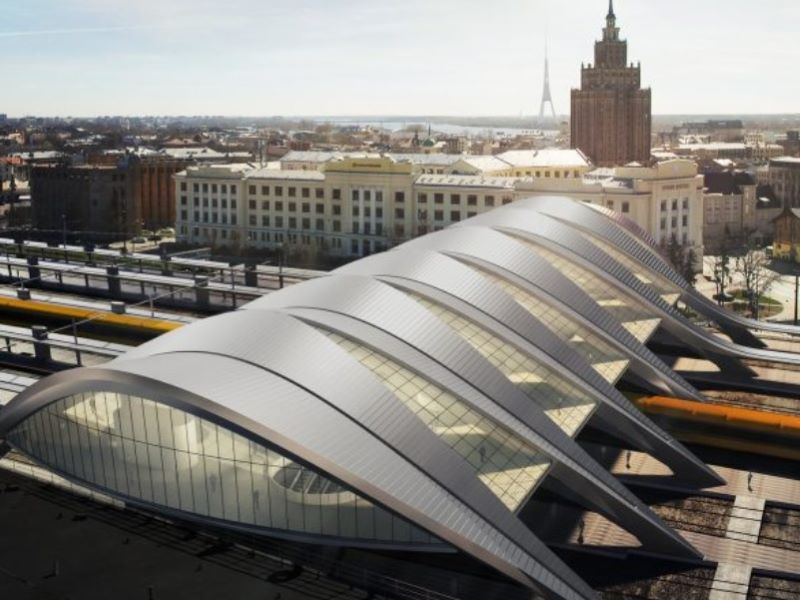
Three international consortiums have qualified for the second stage of the Rail Baltica energy subsystem design and construction procurement, stated RB Rail.

Claimed to be the largest railway cross-border electrification project in Europe, the subsystem will be installed in a consolidated way across all 870km mainline from Tallinn to the Lithuania-Poland border and from Kaunas to Vilnius.
“COBELEC Rail Baltica” from Spain, “ALSTOM-BMGS-GE-Torpol” from Latvia, France and Poland, and STC Baltic Electrification” from France, Germany and Latvia are said to be qualified for the second stage of the tender.
The tender is expected to begin in the following months with an aim to sign the contract by the end of this year.
Key components of the energy subsystem consist of high voltage connection points to link traction power substations to the public high voltage electrical grids and traction power substations.
The components also include an overhead contact system, energy control command system, and other components that are directly linked to the energy subsystem.
The European Union will co-finance up to 85% of the total eligible costs via the Connecting Europe Facility (CEF), while the remaining funds will be provided by Estonia, Latvia, and Lithuania.
At the start of last year, RB Rail chose an engineering service (ENE Engineer).
The association of DB Engineering & Consulting emerged as the winner in an international tender conducted by RB Rail.
Last month, RB Rail launched the international construction supervisor competition for the Rail Baltica mainline construction in Latvia.


