
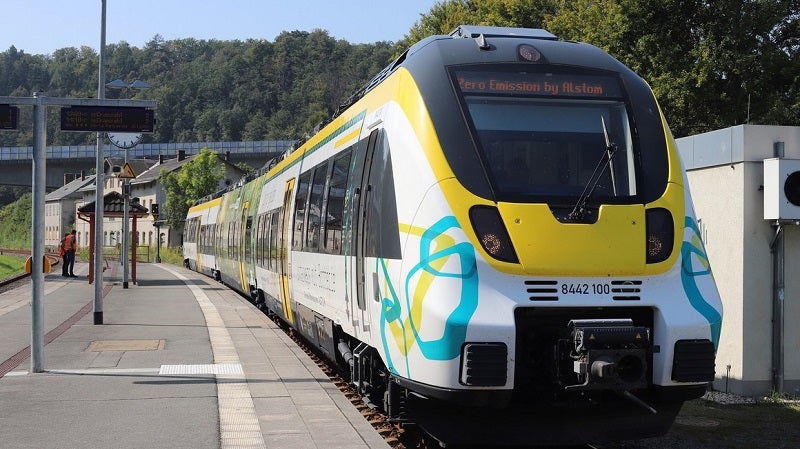
Alstom has carried out a technical demonstration journey of its battery-powered train, which travelled to Flöha and Zschopau and then back to Chemnitz in Germany.
This battery-powered electric multiple unit train was developed as a prototype at Alstom’s Hennigsdorf site.

Discover B2B Marketing That Performs
Combine business intelligence and editorial excellence to reach engaged professionals across 36 leading media platforms.
During the demonstration, the train’s drive was switched to battery power from catenary operation.
Alstom initiated this project in research partnership with the Technical University of Berlin in 2016.
The project involves the development, approval, and operation of the battery-powered passenger trains, along with proving the economic feasibility of battery operation for mainline railways.
It covers the preparation of recommendations for operators and public authorities for running these trains on non-electrified or partially-electrified lines.
US Tariffs are shifting - will you react or anticipate?
Don’t let policy changes catch you off guard. Stay proactive with real-time data and expert analysis.
By GlobalDataThe trains feature a drive system that includes a traction battery developed and tested by the company in Mannheim.
Alstom developed this battery-powered train in collaboration with DB Regio, the German National Innovation Programme for Hydrogen and Fuel Cell Technology, and the Technical University of Berlin.
The project has received around $4.74m (€4m) in funding from the German Federal Ministry of Transport and Digital Infrastructure (BMVI).
Related scientific research at the Technical University of Berlin has been conducted by the Department of Railway Operations and Infrastructure and the Department of Product Development Methods and Mechatronics since the project’s beginning.
Extensive travel dynamics and energy simulations were also conducted under the project, stated Alstom.
Department of Railway Operations and Infrastructure doctor of engineering professor Birgit Milius said: “Our studies have clearly shown that in local rail passenger transport, battery-powered electric vehicles have the potential to successfully replace diesel vehicles.
“Our considerations have always taken the overall system into account. Aspects covering the vehicle, operation and infrastructure were analysed under various operating conditions in order to obtain reliable results.”
After the launch of the new timetable in December this year, the train will commence operations in Baden-Württemberg and Bavaria.
Last month, Alstom announced the debut of its Coradia iLint passenger train in Östersund, Sweden.


