

Transport for Greater Manchester, the regional public transport provider for the English city and its surrounding areas, has revealed its medium-term Rapid Transit Strategy.
The plan has three strands: Bus, tram, and rail.
Go deeper with GlobalData


Discover B2B Marketing That Performs
Combine business intelligence and editorial excellence to reach engaged professionals across 36 leading media platforms.
Mainline rail on eight lines often used by commuters to access the city will be brought under TfGM control as part of the Bee Network, a unified public transit network in the city.
The existing tram network will be extended under the plan, with lines built out to surrounding towns like Middleton and Stockport, and new connections further increasing cross-city links to cut out the need for passengers to travel into the centre of the city and out again to reach parts of Trafford or Salford.
“Greater Manchester is working with the rail industry – and looks forward to working with the new government – to deliver this transformational change across train services, by bringing eight lines into the Bee Network by 2028, with other lines joining by the end of the decade,” TfGM laid out.
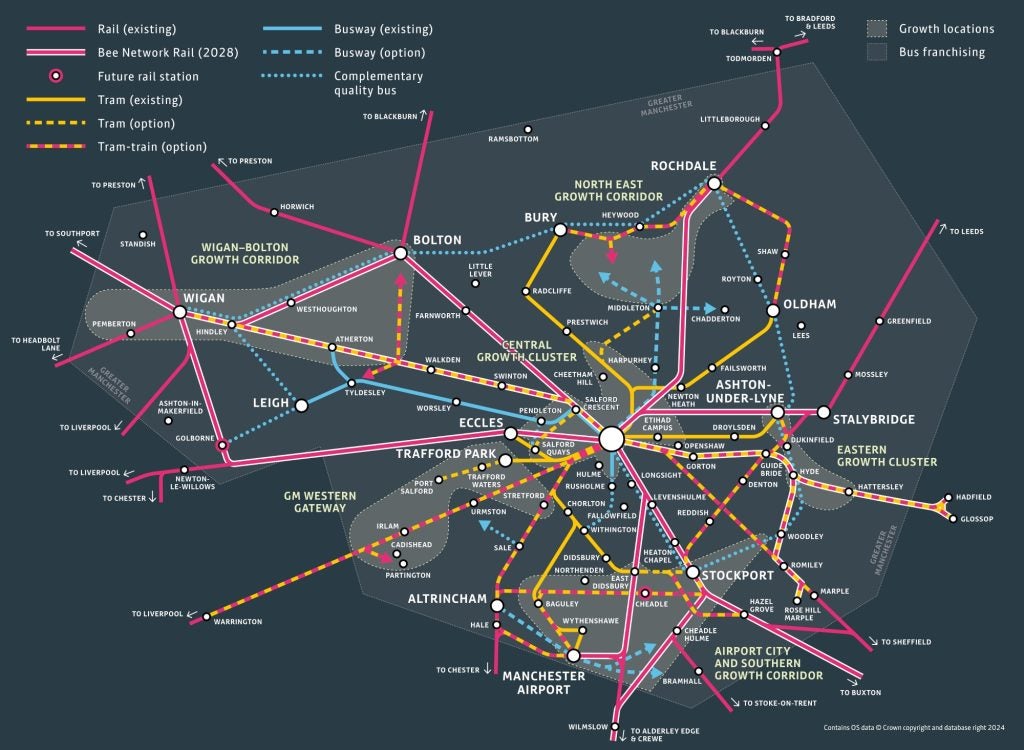
The eight lines to join the Bee Network by 2028 are:
Rochdale stopping services;
Ashton-under-Lyne and Stalybridge;
Glossop, Hadfield and Rose Hill Marple via Guide Bridge;
Alderley Edge and Buxton via Stockport;
Airport stoppers;
Wigan via Golborne;
Wigan via Atherton;
Wigan via Bolton.
Metro Mayor of Greater Manchester Andy Burnham (Labour) said the local authority was looking forward to enacting the plan and working with local and national stakeholders.
“Nowhere else in the country is delivering a plan as ambitious as here in Greater Manchester,” he claimed.
“When we succeed the country succeeds and I look forward to working with this new government to ensure we maximise our role as a leading contributor to sustainable regional and national economic growth,” he said.
The strategy is likely part of the new UK government’s plan to extend national (Scotland, Wales, Northern Ireland) and regional (cities like Manchester, Birmingham and Sheffield) devolution.
TfGM Transport Commissioner Vernon Everitt added: “As part of a new rapid transit strategy, we are working with the rail industry on a detailed timeline to bring eight local train lines into the Bee Network by 2028 alongside work to further extend the hugely successful Metrolink. Delivery of this plan will further increase ridership, driving up revenue for reinvestment in better services.”
But one key transport development that was not promised in the announcement was the potential for an underground station extension to the central Piccadilly Station.
Rail experts and commentators have called for such a development for several years, and Burnham hinted that TfGM would soon look at a longer-term plan (“through to 2040 and beyond”) which would likely consider further tunnelling and high-speed development into the city.


