


Braunschweig (Brunswick), Germany, is the focal point of a projected tram-train operation covering a large area in the east of Niedersachsen (Lower Saxony).
Formulated in the 1990s, the RegioStadtBahn (RSB) scheme is being promoted by state transport authority Landesnahverkehrsgesellschaft Niedersachsen and Zweckverband Grossraum Braunschweig, the regional development body and collective organisation for the communities covered by the scheme.
Recommended Buyers Guides

The project
RSB interest groups signed a letter of intent in September 2008. Construction was orginally scheduled to begin in 2009, but has now been postponed until 2014. The current main rail interests are DB’s regional train operations (DB Regio) and infrastructure (DB Netz) arms, and the city transport organisation Braunschweiger Verkehrs AG.
Project aims include upgrading the present facilities, improving accessibility and increasing the number of services. The main roads around Braunschweig are known for their traffic congestion, and the RSB could offset this by making rail journeys more feasible.
The RSB will be formed mainly on a north-south axis, with the northern limit at Uelzen – 80km (50 miles) north of Braunschweig – providing an interchange with the Hamburg-Hannover main line.
The southwards line will branch at Wolfenbüttel; southwestwards, the line will stop at several stations on the way to Salzgitter, while the southeastern arm will connect Goslar, Bad Harzburg and Schöppenstedt.
Funding for the project was finalised in July 2009. Planning and construction is estimated at €232.5m, of which €197.4m was allocated to modernisation and the construction of railway tracks, stations and planned stops. The contributors are the federal (60%) and Niedersachsen (22.5%) governments, administration union (7.5%) and the affected municipalities, cities and counties (10%).
Project planning costs amounted to €35.1m. This was chiefly financed by Greater Brunswick Zweckverband ($30.1m), with the remainder coming from the affected cities and municipalities.
Infrastructure
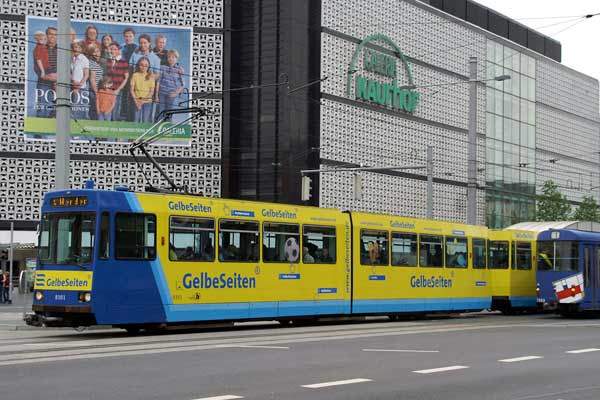
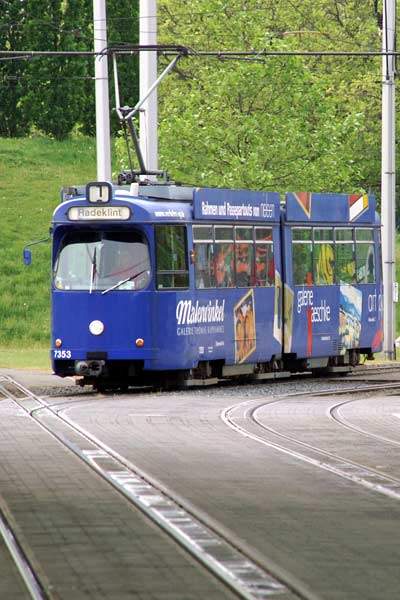
Braunschweig trams use an unusual 1,100mm gauge, while the national rail network uses the standard 1,435mm gauge.
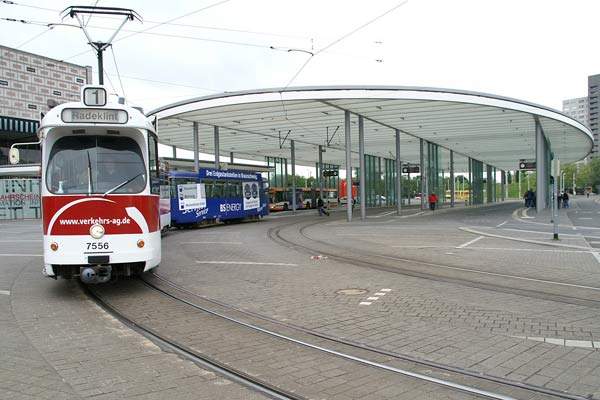
Three rail sections have been created as part of other works, well in advance of the commitment being made to start work on this project. These include the large combined bus and tram stop at Berliner Platz in front of Braunschweig Hauptbahnhof (the central station). This stop will have much higher frequency levels than at present, being on the core section which would accommodate all four RSB routes in the initial scheme.
South of Braunschweig city centre, a link between heavy rail and tram tracks will be installed just to the west of the main station. The other will involve use of an industrial siding for Braunschweig Nordbahnhof, a through station that will also be a terminus for two routes extending south of the city. New trackwork will also be needed in western Salzgitter.
The majority of the proposed 185km (116-mile), four-route RSB will service 63 stations (some new) and would mainly use existing DB Netz heavy rail tracks, currently covered by a mix of regional train types.
The first stage involves construction of the four lines – S1, S2, S3 and S10:
- Line S1 will connect Uelzen to Bad Harzburg via Braunschweig (city centre).
- Line S2 will connect Braunschweig north station to Schöppenstedt via Braunschweig (city centre).
- Line S3 starts from Braunschweig north station, connecting Braunschweig (city centre), Salzgitter Thiede, Salzgitter town centre gate and Salzgitter-Fredenberg.
- Line S10 will start from Sitting Castle Triangle and connects GIF horn (city centre), Braunschweig (city centre), Wolfenbuttel-Vienenburg and Goslar.
Rolling stock
Dual-system vehicles capable of operating on main lines and tram tracks as well as under their respective control systems will be required. Unlike the fully electrified pioneer among German tram-train operations at Karlsruhe that began two-system track sharing in September 1992, as unwired DB tracks would be involved for the RSB, units with diesel power will be needed.
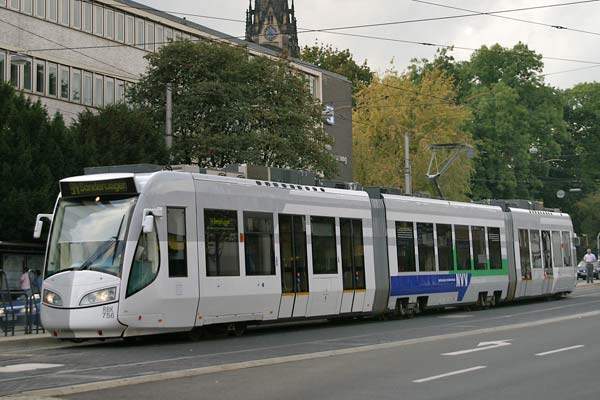
Featuring in promotional materials for the RSB project, a strong candidate appears to be the Alstom Regio Citadis, an Alstom Deutschland product from Salzgitter (also on the proposed RSB network), location of the former Linke-Hoffman-Busch plant. An established specialist in regional and urban rail vehicles, Linke-Hoffman-Busch has previously supplied trams to Braunschweig.
Two variants of the three-section Alstom Regio Citadis – the 15kV DC/750V AC and diesel/750V AC – are the basis of the Kassel tram-train system in the neighbouring state of Hessen that became fully operational in 2007. Procurement of vehicles for the RSB was not part of the late 2008 announcement.
Signalling and communications
Tram signals and light-of-sight principles apply on the Braunschweig tramway, but elsewhere they run under DB Netz signalling. The RSB would become part of the integrated ticketing arrangements of the individual communities and the region.
The future
Construction was expected to begin during late 2009 with a target start of services in 2012, but due to political reasons, the start of services has now been postponed to 2014.
The construction schedule is also yet to be announced. The potential exists for more of the Braunschweig region’s lines to be incorporated in the RSB. Supporters of the scheme in Wolfsburg, 33km (21 miles) north-east of Braunschweig are seeking to have the project extended to their city at an early stage.
