

The 2008 Olympic Games led to a huge investment in transport systems throughout China’s capital city Beijing. As the traffic increased from 72 million in 1982 to 558 million in 1995, transportation became a major problem in the Beijing area. It was expected to worsen during the 2008 Olympics.
The Beijing Capital International Airport-Dongzhimen express rail link project is a 28.14km rail link between Beijing Capital International Airport and Dongzhimen. The five-year construction programme started in 2002. Three new subway lines were built in time for the Olympics.
Recommended Buyers Guides

These created 148.5km (92.8 miles) of new rail transport, capable of handling around 10% of the passengers in the city. By then, the total subway/rapid transit network was 202km (126 miles) long, providing the capacity needed.
The project
The Beijing Capital International Airport-Dongzhimen express rail link is the most advanced rail system in the capital. Its builder is the Beijing Dongzhimen Airport Express Rail Company, and the first contracts for construction and equipment were let to China’s Changchun Railway Vehicles (CRV) in partnership with Bombardier Transportation.
Beijing’s subway lines have been expanded from a two-line network to five, including a special Olympic branch. Lines 1 and 2 were already in full service, and no extensions were planned. Line 4 is a brand new 28.14km line with 24 stations. It was completed in 2008 and became operational in September 2009. Line 5 is a 27.6km north-south subway line, 16.9km underground, with 22 stations in total. Line 5 opened in October 2007. Line 8 and Line 10 opened in June 2008 just before the Olympics.
The third, and the most important of the subway lines, is the Olympic branch, 30.5km long with 26 stations, and construction started in 2004. It links Huoquiying in west Beijing with the north of the city and the Olympic venues and features interchanges with lines 1, 4, 5 and the elevated City Rail Line 13.
Infrastructure
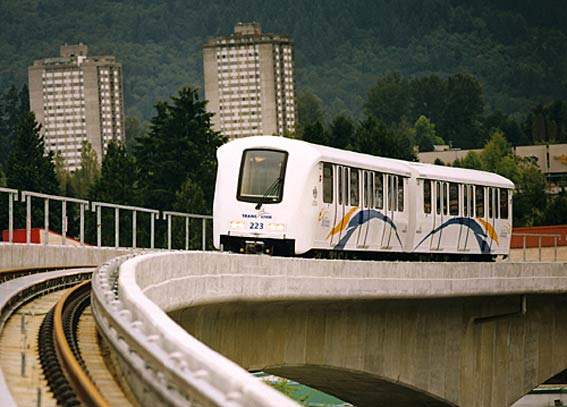
The new express line to Beijing Airport features driverless operation using Bombardier’s proven Advanced Rapid Transit technology, which is already in use on the Vancouver Sky Train (the longest driverless system in the world) and New York’s 13km air train.
The 28km line starts from Dongzhimen and ends at new Beijing Capital International Airport. It has four stations, at Dongzhimen (transfers Line 2 and Line 13, Sanyuanqiao (transfers Line 10), and Terminal 2 and Terminal 3 of the airport. Dongzhimen and Sanyuanqiao are interchanges for the subway or other modes of transport to reach the heart of the Olympic Village. At Dongzhimen station, passengers can start their first steps of pre-flight check-in procedures before arrival at the airport.
The express line is expected to carry up to 4,500 passengers per hour at peak times and 400,000 passengers a day, with trains running for 15 hours every day. The whole project cost ¥5.4bn with a consortium of five Chinese companies involved, including CRV.
It received funds through a joint venture with the Hong Kong MTR. All lines now collect fares through automatic fare collection machines that accept single-ride tickets and an integrated circuit card that can store credit for multiple rides. A flat fare for the Air Express is ¥25.00 while it is ¥2 for the rest.
Rolling stock
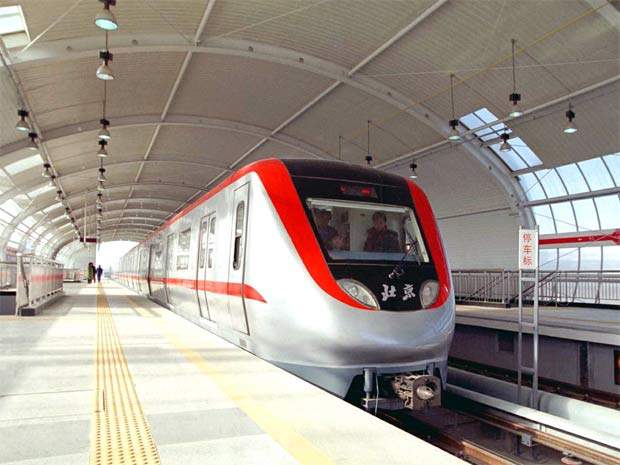
Bombardier has been contracted to provide the express line with 40 new trains. The bodies for these ART Mk II vehicles are built by CRV, with Bombardier providing the electrical systems, bogies and propulsion and brake systems, as well as managing the project.
A tight delivery schedule was imposed on Bombardier; less than two years after the US$44m contract was awarded in March 2006.
The new vehicles are exclusively for the airport link, allowing Bombardier to showcase its technology at a major international event. They are capable of reaching 100km/h (62.5mph), making the entire journey just 16 minutes long.
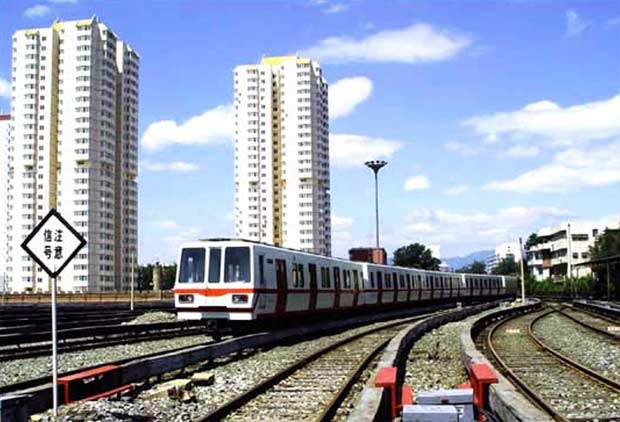
On the subway, a variety of different trains are in service, all of Chinese origin and running on the 750V DC system, collecting current from a third rail.
Signalling and communications
Bombardier has provided the signalling systems to interconnect with the driverless trains. Communications systems are provided both for railway staff and the passengers using the trains.
The future
Between 2006 and 2010, Beijing is planning to invest 60% of its budget on transport projects. This will see the metro system expand even further to eventually become a 270km (168 miles) system, with more new lines in the early stages of planning.
The majority of the projects under construction were finished before the Olympic Games, apart from completion of the metro system – a total of 408km (254 miles) of lines are planned, but much of this is still at the design stage.
As of 2009, seven lines are under construction. Work on another six lines began in 2009. The whole network is expected to double in size to 420km by 2012. A total of 19 lines and 561km of track will be in operation by 2015.
