

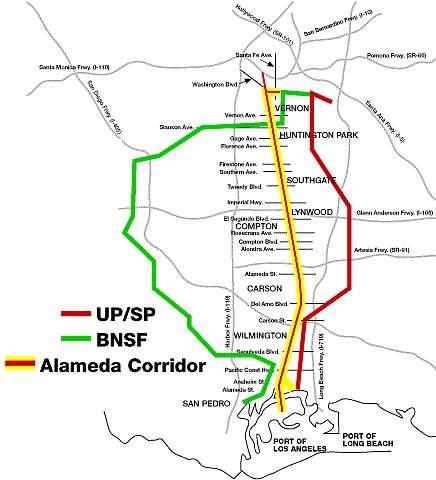
Severe congestion on rail routes on the west coast of America resulted in a $2.4bn investment in the Alameda Corridor to provide a suitable route for heavy trains from the ports of Los Angeles and Long Beach, in California’s San Pedro Bay.
It followed a decade of spectacular growth which has made the ports of Los Angeles and Long Beach the busiest in America. Booming trade with Pacific Rim nations saw trade in the two ports reach 100 million tonnes per year and forecasts show that growth is set to treble in the next 20 years, with the volume of high-value containerised freight.
Recommended White Papers

Recommended Buyers Guides

About one-quarter of all products arriving in the US moves through the ports of Long Beach and Los Angeles, and both remain within the top 20 busiest container ports in the world.
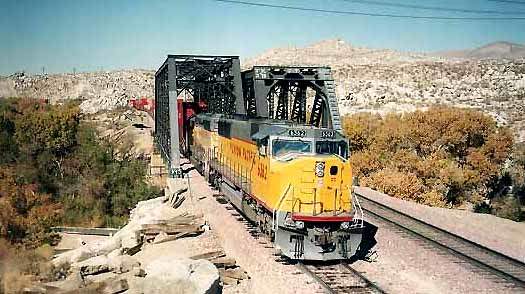
The region is served by two major rail operators, Burlington Northern Santa Fe (BNSF), and Union Pacific (UP). The BNSF was formed in 1994, following the takeover by Fort Worth, Texas-based Burlington Northern, of the Atchison and Topeka and Santa Fe Railway Company. The combined company has a total network of 52,800km-long route (around 33,000 miles), and is the second largest rail carrier in the United States, behind CSX Transportation. The UP is one of four business units of the holding company Union Pacific Corporation.
UPRC lost out to Burlington Northern in the takeover battle for Santa Fe, but in 1995 bought the Southern Pacific Rail Corporation for $5.4bn.
The UP’s first move into passenger operations came in 1993, operating commuter trains into Los Angeles under contract, and UPRC has set up a commuter rail development team to pursue similar openings. It is far and away still predominantly a freight carrier, with grain, coal and intermodal traffic all important traffic areas.
The project
Both companies had to face the considerable obstacle of four single-track routes into the ports area, which include trains up to 2.5km-long having to negotiate up to 200 level crossings that are strung along the four lines and necessitate a maximum speed of just 32km/h (22mph).
Up to 35 trains per day have had to thread their way through the streets of LA at speeds of between 10 and 20mph, which was unsustainable with the massive growth in rail born freight traffic.
The idea of developing a single, consolidated rail corridor in the area was first brought up in 1984, but it was five years before Los Angeles and Long Beach established the Alameda Corridor Transport Authority (ACTA). Design and construction work on the $2.4bn (£1.35bn) project was completed in 2002. The four existing routes are replaced by a single consolidated, grade-separated 32km (20 miles) line, connecting with the existing rail network at Redondo Junction, near where the present route crosses the Los Angeles River.
Promoters hope the line will handle 100 trains a day by 2020, significantly reducing the number of road freight movements a day into the area, which stood at 20,000 per day before the new line. Average speed of freight trains is expected to double to 35mph to 40mph, and during 2007 about 18,000 trains used the route with, on average, 50 running every day.
During 1995 the project was given federal authorisation, and designated a high-priority intermodal corridor, opening the door to a range of ground-breaking financing options, but the acquisition of federal approval came far more quickly than the necessary finance.
In January 1998, approval of a $400m federal loan by President Clinton put the final piece of the funding jigsaw in place, to which the federal government added $47m in an Intermodal Surface Transportation Efficiency Act and other payments.
The project has been funded by a public-private partnership to raise the necessary $2.4bn. Of this $1.165bn has come from revenue bond proceeds, $394m from the port authorities, $347m administered by the Los Angeles County Metropolitan Transportation Authority and $154m from other state and federal sources.
The $400m federal loan will be repaid by user fees from the railroads, which initially cost $15 for each loaded 20-foot equivalent unit (TEU) container, $4 for each empty container, and $8 for other types of loaded rail cars such as tankers and coal carriers.
Depending on inflation, fees are set to increase by between 1.5% and 3% over a 30-year period. As of 1 January 2008, fees stood at $18.67, $4.73 and $9.47 respectively.
Rolling stock
Trains using the line are standard US rolling stock, with large General Motors or General Electric diesel locomotives hauling container wagons, often stacked two high, piggyback trains, mixed freight and other bulk goods such as coal or oil.
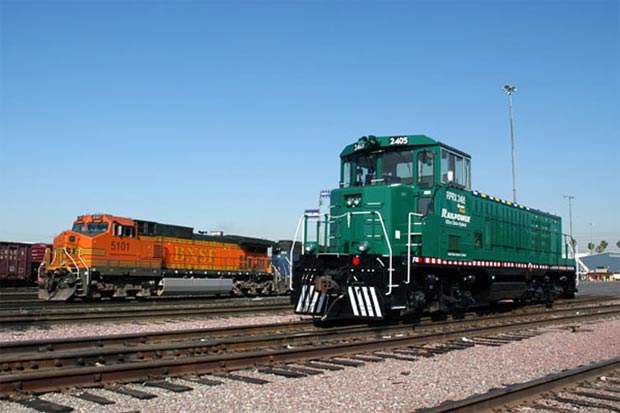
In 2005, ACTA began trials with an alternative fuel locomotive for shunting duties at the yards of Pacific Harbour Line, to try and reduce further the amount of air pollution created by the ports. The ‘Green Goat’ Bo-Bo locomotive uses a small diesel generator combined with a set of high powered long life batteries, which reduce emissions by more than 80%. Although no new locomotives had been ordered by 2006, the trials were an all-out success.
Infrastructure
Construction work began in 1997, and started on the bridge over the Los Angeles River at Redondo Junction in May 1998. All work was completed by 2002, with the Redondo Junction allowing a three-minute journey time reduction for passenger trains from Los Angeles Union Station due to the loss of tight curves.
Motorists also benefited from the construction of the new line, as 200 level crossings which were often blocked by 2.5km long trains have been removed.
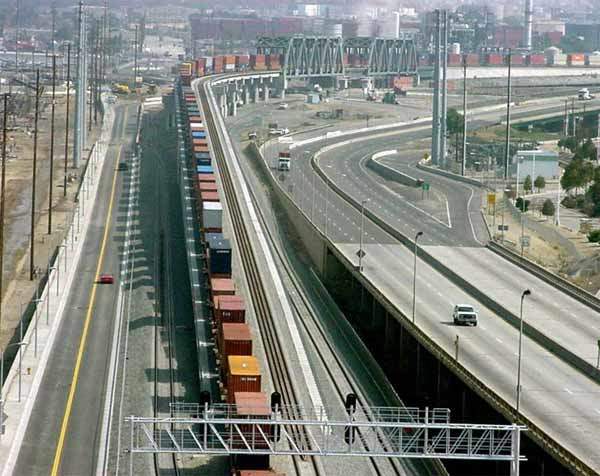
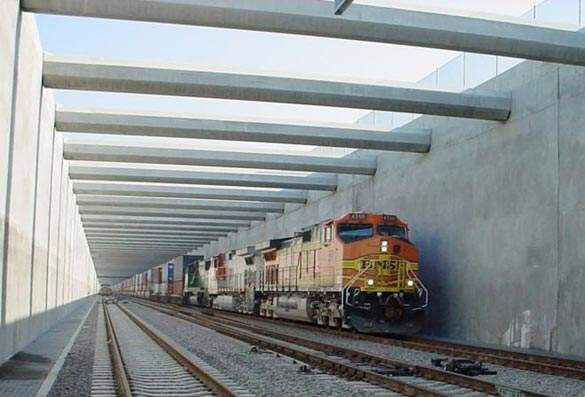
The central feature of the Alameda Corridor is a 33ft-deep trench, running for 10 miles parallel to Alameda Street from downtown LA to ports on the Pacific Ocean coast. This is the centrepiece of the Alameda Corridor, and the largest contract to be awarded. Construction of the trench took three years between 1998 and 2001.
Track and signalling
The ten mile (16km) Mid-Corridor Trench at the centre of Alameda Street, which carries the line under the existing road from Route 91 in Compton to 25th Street near Los Angeles city centre, is 15.2m-wide and accommodates two tracks plus a roadway for maintenance access. This could be converted into a third rail line if required. The trench has an overhead clearance of 7.5m for double-stack container trains.
Linking the new route with existing rail lines at its northern end has required extensive construction works. The line curves eastward at 25th Avenue, and rises to surface level alongside Santa Fe Avenue, where major grade separation works will be needed.
A two-track link is provided between the corridor, over an existing bridge over the Los Angeles river, into Union Pacific’s East Los Angeles Yard, connecting with existing lines to the north. A new double-track flyover and bridge over the Los Angeles River also avoids freight movements along the new corridor conflicting with Amtrak and Metrolink passenger services.
At the southern end, there is a grade separation to carry the corridor over Henry Ford Avenue in Wilmington. Another major river crossing is over the Dominguez Channel in Long Beach.
In December 2007, the Alameda Corridor Transport Authority (ACTA) contracted So Pac Rail to begin construction of the CP Thenard Track Connection (also known as K-Pac Track Connection), which will provide a signalised track connection from the BNSF Railway’s Watson Yard to the former Southern Pacific Railroad’s San Pedro Branch. The estimated $8.8m project is to provide an alternate connection from Long Beach Lead to the corridor and is scheduled for completion by late 2008.
The future
Negotiations over construction management contracts for the scheme were begun in mid-1998, and the 2001 completion target was achieved by adopting a ‘design-build’ strategy for the Alameda Street trench section. However, the line did not open officially until April 2002.
Other agencies involved in the project are the cities of Carson and Los Angeles, who have constructed road overbridges.
The main priority for ACTA is to continue reducing emissions from the ports and increase traffic levels. The authority believes more than 8,000t of total emission reductions have resulted from the consolidation of freight rail operations and the alleviation of traffic congestion at the 200-plus rail crossing in the Southland.
The Alameda Corridor has experienced a steady increase in the number of trains since its opening. During its first full year of operation in 2003, 14,000 trains utilised the facility. By 2007, it had carried 18,000 trains at an average of nearly 50 trains per day. There is, however, still some way to go before the target of 100 trains per day is reached.
During its first six years, the corridor carried more than 12 million containers or 21 million TEUs. It is estimated that each day more than 7,200 containers (13,000 TEUs) are transported via the Alameda Corridor, which constitutes almost one-third of the port’s average daily volume.
In April 2008, the Alameda Corridor reached an important milestone when the 100,000th train to use the connection was recorded.
