

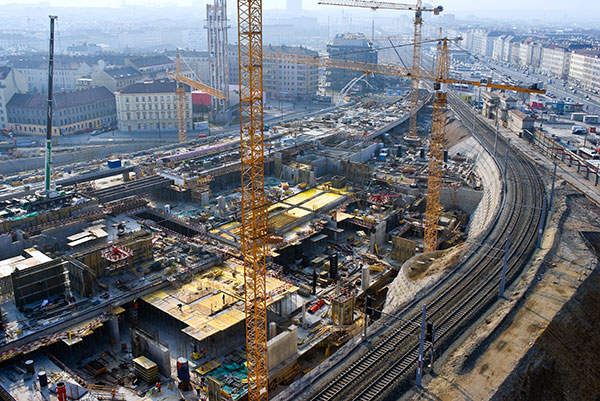
Vienna Central Station, also known as Wien Hauptbahnhof (Vienna Main Train Station), is the largest railway station built in Vienna, Austria, replacing the old Südbahnhof terminal station. ÖBB-Infrastruktur is the owner of the project.
Recommended White Papers
Recommended Buyers Guides

The station links four major railway lines, which meet at Vienna from four directions. It offers significantly improved connectivity across nations and also provides access to the Vienna S-Bahn, tramway and bus lines.
It is estimated that the station will be used by 120,000 passengers and up to 1,000 trains a day by 2025.
The station was partially opened in December 2012 and opened for operations in October 2014. It was fully operational in December 2015.
Project approval for Vienna Central Station
Vienna city council approved the construction of the new station building in December 2006. The environmental assessment for the rail infrastructure began in 2007.
The project involved the construction of a 20,000m² new station building and of a new Austrian Federal Railways headquarters building next to it.
It also included the development of a 109ha area surrounding the new station, with 5,000 residential apartments in Sonnwendviertel and 550,000m² of office space.
The estimated investment for the whole project is €4bn ($5.06bn). It was financed by ÖBB master plan, the community of Vienna, TEN-aids and ÖBB real estate revenues.
Design of the major Austrian station
The station features a 25,000m² diamond-shaped, translucent, glass and steel roof over the platforms. It is a transportation hub with 100km of new rails, in addition to 300 state-of-the-art switches and crossings.
The station is energy-efficient and environmental-friendly as it is designed to have integrated CO2-controlled ventilation and geothermal energy systems. The windows and walls of the station are soundproof.
Construction of the Wien Hauptbahnhof
Preconstruction works included alteration and modernisation of the facilities at the Südtiroler Platz station. These works began in June 2007. The S-Bahn and U-Bahn stations at Südtiroler Platz were connected in 2008.
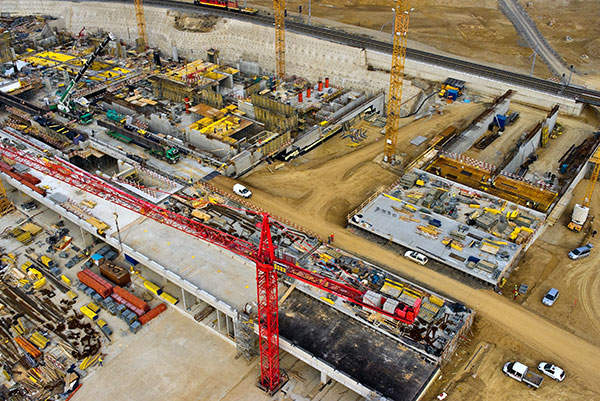
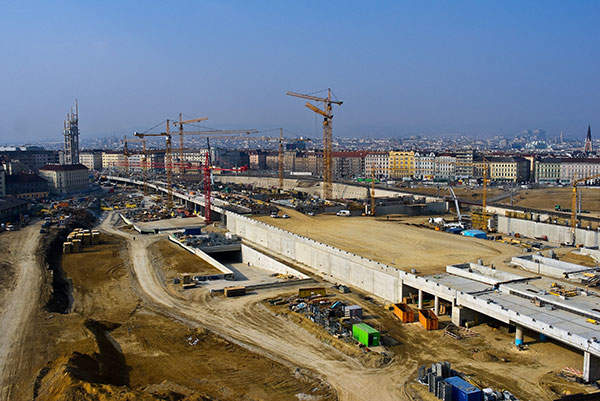
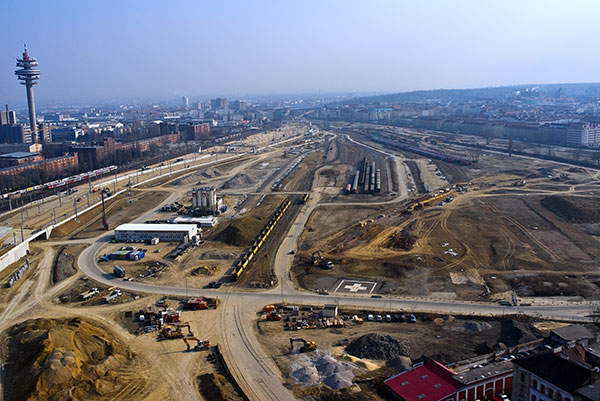
In November 2009, the main station’s construction started on the eastern plant, with excavation work undertaken for roads and logistic areas. The demolition of the old Südbahnhof station and the railway systems began in December 2009 and was completed in August 2010.
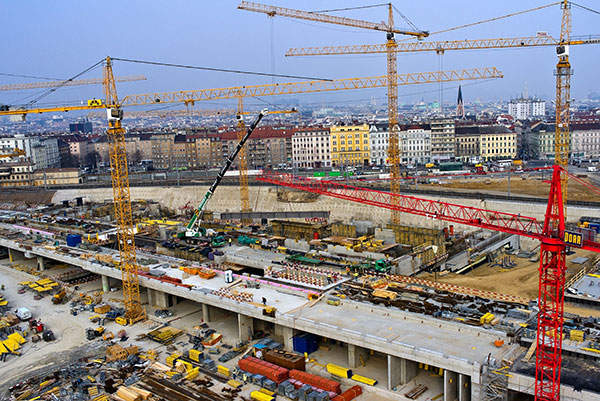
The construction of rail infrastructure at Vienna Central Station was commenced in 2010. More than 45,000m³ of concrete was used in the construction of the baseplate of the station and the garage entrance. The construction of bridge support structures and platforms was completed by the end of 2010.
In 2011, construction of office buildings in the Belvedere district began. Construction of the new Austrian Federal Railways headquarters building and apartments began in 2011 and early 2012, respectively.
Contractors involved with Vienna’s train station
In November 2009, a Strabag-led consortium was awarded a €220m ($278.69m) contract to build the new Vienna Central Station. Strabag holds a 30% share in the contract.
The joint venture of Arge Östu-Stettin and HOCHTIEF Construction was awarded a €5.9m ($7.40m) contract for the railway infrastructure. The scope of the contract includes construction of truncated east station, provisional east railway yard with a storage capacity of 3,320m and a bypass track.
Liebherr Group was awarded the contract to provide nine Liebherr 280 EC-H 12 Litronic tower cranes for the construction of the station building.
Zechner & Zechner ZT were the architects for the new Austrian Federal Railways headquarters building.
The diamond-shaped roof of the station was installed by UNGER Steel.
Facilities at Vienna’s new railway station
The new railway station has 16 tracks and 15 platforms, including five roofed platforms and ten platform edges. The width of the platform is 12.1m. The station has 100 shops and restaurants.
The passenger facilities include escalators and elevators, train information displays and waiting rooms. There is a parking garage below the station, with more than 600 spaces.
The central station allows passengers to change trains on the same platform. The new station is closer to Südtiroler Platz underground station than the former building and includes an underground walkway to connect the two stations.
