


Capital of the Midi-Pyrénées region, Toulouse, in south-west France is the centre of one of Europe’s fastest-growing metropolitan areas with an estimated population of over 1.1 million. It has serious transport problems that could worsen because expansion is taking place in regenerated wastelands with a poor road network.
In spite of economic growth underpinned by military, aerospace and research concentrations, tensions and unrest have arisen due in part to socio-economic divisions evolving in the spreading city.
Recommended White Papers
Recommended Buyers Guides

Toulouse has gradually adopted a blend of public transport modes in addition to buses, initially a high-frequency rubber-tyred partly in-tunnel VAL metro. This was followed by an overhaul of suburban line services for intensive use and most recently, now due to open in 2010, a conventional surface tramway.
The loss of central government support however means that the financial burden for expansion now rests on local taxation, not an altogether popular move. Urban transport services operate under the Tisséo brand launched in 2002.
The project
Authorisation for the construction of the 10km (6.33 mile) long Line A in 1985. It was to be a fully automated VAL (Véhicule Automatique Léger) system based on the successful model established in the northern French city of Lille.
Now a Siemens format, VAL comprises automatic rubber-tyred vehicles, using technology devised by Professor Robert Gabillard for Matra’s 1983 Lille system.
Line A opened on 26 June 1993 and was extended in December 2003, running mostly underground from Basso Cambo in the south, and through the city centre to Balma-Gramont. It includes interchange with the principal SNCF station at the Marengo stop. The construction of Line B started in 2002. Another VAL, it opened as a 15km (9.4 mile) stretch in June 2007, providing an interchange with Line A at Jean-Jaurés.
Also part of the national network, heavy rail Line C, solving the pressing needs of the eastern side of Toulouse, required SNCF to import the ideas of Paris’ high-frequency, high-capacity RER to upgrade an existing 7km line. Since 1 September 2003, the dormitory suburb of Colomiers has enjoyed a journey time of less than 30 minutes into central Toulouse, interchanging with Line A at St Cyprien-Arènes.
A further RER-type expansion is Line D to the southern township of Muret, making greater use of the present SNCF line from Marengo (a Line A interchange) and crossing Line B at Saint Agne SNCF.
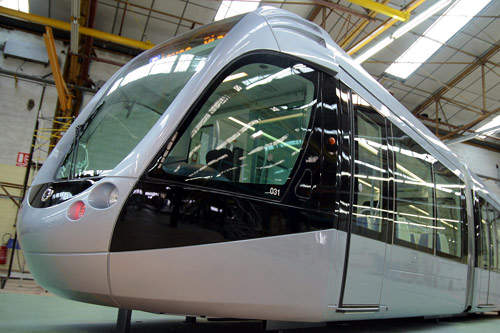
Line E is potentially the first of several modern tramways, a late adoption of a mode that has become a mainstay of transport systems in many French cities. Costing €200m, it starts at Les Arenes Metro and heads north-west through densely populated housing areas and past important public buildings to Blagnac, location of Airbus headquarters and assembly plant.
Rolling stock
On Line A, two-car trains accommodating up to 200 passengers operate between 05:30am and 12:30am. The VAL206 and newer VAL208, are built to handle 7% gradients and can reach 60km/h (38mph). With simple interiors because passengers are not aboard for a long time, the cars have internal displays announcing the next stopping place.
The ability to use a common fleet for Line B is estimated to have saved substantial sums, a major factor in the order of 34 additional sets. Non-specific, Paris-style RER mainline stock is employed on Lines C and D. As part of the Line E tramway project, an order was placed with Alstom in June 2006 for 18 bi-directional 100% low-floor Citadis type 302 trams.
Infrastructure
For the first line Adtranz (later Bombardier) subsidiary ABB Energie, based at Nanterre, built and equipped five traction and 15 distribution sub-stations with the subsequent expansions using common types of equipment.
The new lines make use of the expanded original workshop and train stabling facility at Basso Cambo, although a second depot is set up at Line B terminus Ramonville. Line C and D have required little major alteration from the existing railway.
As with heavy rail counterparts, Toulouse’s underground and elevated metro stations are substantial structures. Line B introduced longer platforms and the better use of light to offset the sometimes oppressive VAL installations.
Platforms are edged by a glass partition to prevent passengers falling and for channelling them to the automatically activated doorways onto trains.
Decoration of the VAL’s 38 stops are the basis of the operator claiming them as being art galleries. Relative to creating the metro, Line C and D required little major alteration from the previous railway operation.
Signalling and communications
The driverless control system used on the VAL lines is a development of the PA135 ‘driver’s aid’, a central feature of Paris Metro operation. The system is governed by the Sacem automatic signalling concept, which was developed by MTI in conjunction with Alstom. Line B employs an automatic, numeric operation system monitored by control centre operators via multi-media consoles. The Toulouse VAL system reports an extremely high level of system availability.
The system has been proved through its use on the previous incarnations of the VAL concept in use in Lille, Chicago and Taipei. The developers boast that in the 16 years of operation before it was chosen for Toulouse not a single accident had been recorded.
There is a high level of security on the system with 250 CCTV cameras in place, a high visible staff presence and a determined anti-graffiti policy.
The future
The medium-term public transport blueprint for Toulouse is under constant review, and expansion of VAL, commuter rail and light rail is possible. Platform lengthening is required on Line A to provide much-needed capacity increase.
With construction starting in 2007, the €250m Line E tramway project is for an 18-station 10.9km (6.8 mile) line on a broadly north-south axis west of the Garonne covering the Beauzelle, Blagnac and Toulouse communes.
The depot is at the northern end near the Garossos terminus. Southern terminus Arènes provides interchanges with lines A and C. Revenue services are expected to begin in 2010 with projected daily passenger levels of 25,000–30,000 and a potential peak interval of five minutes. A future Line E extension would give rail access to Toulouse Blagnac Airport.
