


Vancouver is Canada’s third city, the metropolitan area having a population approaching 2.3 million and projected for 3 million by 2030.
An important port on the Pacific Rim, close to the US border and the region’s main transport hub, the city has a high standard of living. Developed on land, bounded by water on three sides, the core of the city has a high population density by North American standards.
Recommended White Papers
Recommended Buyers Guides

The project
The SkyTrain project was linked to Vancouver hosting the 1986 transportation and communication-themed Expo 86World Fair, an event that pump-primed the city’s rising profile and fortunes. The system originated in eastern Canada with the Ontario (later Urban) Transportation Development Corporation (UTDC), a body funded to create a mode of Intermediate Capacity Transit System (ICTS), being between light rail and heavy rail/metro.
With relatively rapid installation, subsequent owners of the format, Bombardier, also promote the mode as being half the cost of a metro, having the capability for small radius curves and steep inclines, low-cost stations, and the long-term economies of driverless operation.
Like the ICTS format, Vancouver SkyTrain was publicly funded. The project combined UTDC’s need for a high-profile showcase for their system and a need for high-volume public transport for Expo and Vancouver in the longer-term.
Following a short section being used for proving, the first line opened for revenue services in January 1986, including the link between Canada’s own Expo pavilion and the rest of the exhibition grounds.
The first public ICTS application was Toronto’s Scarborough RT line opened in 1985, although unlike SkyTrain this has not been extended and its continued operation is uncertain.
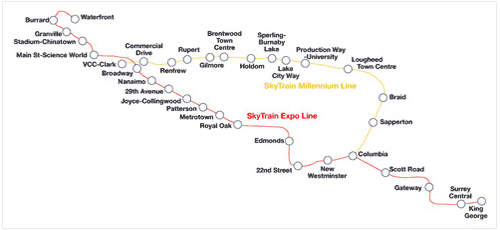
Becoming the Expo Line after a second SkyTrain route opened, the first was extended in two stages to the eastern terminus of King George by 1994. Using the Expo Line as far as Columbia, the Millennium Line loops north back into the city centre, where Commercial Drive (an interchange with the Expo Line) was terminus from 2002 until the delayed VCC-Clark station opened in 2006.
From the 16 million passenger trips taken during 1990, system expansion and rising popularity had increased this figure to 42 million for 2007. This approximates to about a third of the annual ridership of trolley buses/buses in the metropolitan area.
In June 2008 Translink reported a much higher than forecast extra 2.6% ridership for the year, attributed to a combination of service expansion and the transfer from private cars due to rising fuel costs. The Federation of Canadian Municipalities and Canadian Urban Transit Association stated in 2008 that nationally public transport systems were becoming less able to accommodate demand in urban areas.
Under the Translink branding and run by subsidiary British Columbia Rapid Transit Company Ltd, SkyTrain is part of the South Coast British Columbia Transportation Authority (formerly Greater Vancouver Transportation Authority). Translink also operates the West Coast Express heavy rail commuter service.
Infrastructure
Beyond the Waterfront terminus, the former heavy rail Dunsmuir tunnel was redeployed in a double-deck, single-track configuration incorporating two stations. Most of the system uses paired tracks and stations on prefabricated elevated concrete decks, the whole being grade-separated throughout from other transport modes.
Power supply by third rail and the reaction plate for the train’s linear induction motors are incorporated in a permanent way. A notable work is the 616m (2,020ft) Skybridge Fraser River crossing that is dedicated to SkyTrain use. The system’s maintenance and control centre is between Edmunds and 22nd Street stations.
Rolling stock
The first vehicles were by UTDC, the assets of the organisation passing to Bombardier in 1992 who has continued as a supplier to the system. The format has been developed as Bombardier’s Advanced Rapid Transit (ART) which in 2008 passed the milestone of 600 vehicles ordered when Vancouver took up an option for more stock. Other applications include Beijing International and New York JFK airports, Kuala Lumpur and Detroit.
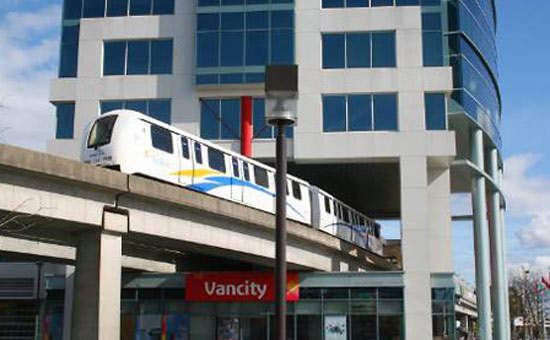
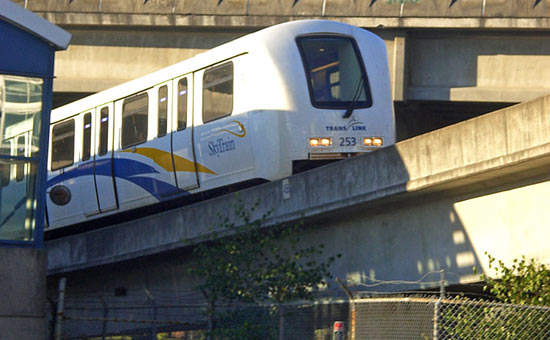
Although usually associated with MAGLEV operation, linear induction motors provide propulsion for SkyTrain units. The fleet is composed of 150 vehicles of ART I stock and 108 ART II, the latter ordered from 1998. ART II units are wider and provide better access than their predecessors.
In 2006, Translink formed a C$113.21m contract with Bombardier for the supply of 34 extra ART II vehicles (with options), the first due for delivery in 2009.
Usually running in multiples of paired vehicles, ART II pairs are articulated, platform lengths impose a six-vehicle limit. They cover equivalent urban routings in around half the time of Vancouver’s express bus services.
Signalling and communications
SkyTrain uses moving-block automatic train control which allows for very short headways and facilitates rapidly changing capacity according to demand. Intrusions onto the tracks are detected by an alarm system fitted throughout. Over the sections carrying both lines, peak frequency is every two minutes. The single line lowest frequency is every eight minutes.
As part of an integrated public transport operation which also includes buses, trolleybuses and ferries, zone-based single tickets allow for up to 90 minutes of travel by any combination of modes, with other ticketing options available.
The future
Vancouver’s current major rail project is the north-south C$1.8bn (as of 2003) Canada Line, which although with automatic operation, is not physically part of SkyTrain system and uses different technology. The public-private partnership funded line is scheduled to open in November 2009, its airport-city centre connection (which began commissioning in April 2008) of importance to Vancouver’s hosting of the 2010 Winter Olympics and Paralympics.
In a reversal of previous intentions for a light rail system, it was announced in February 2008 that the C$1.4bn Evergreen Line project will use advanced light rapid transit (ALRT), technology as per SkyTrain.
Although the branding has not been announced, the Evergreen Line, due to open in 2014, will connect with SkyTrain Millennium Line at Lougheed Town Centre, running north-east to Coquitlam Town Centre.
In 2007 Translink reported covering SkyTrain operating costs through fares. Current works include expansion of maintenance facilities and station upgrades. Independent of the Evergreen and Canada line projects, the success of SkyTrain indicates that extension of present lines is likely.
For a 60-day period in connection with the 2010 Winter Olympics, Vancouver is to operate a trial light rail streetcar service. Connecting Granville Island and the forthcoming Canada Line Cambie Street station, the 1.8km (1.1 mile) stretch to be officially titled ‘The Olympic Line’ is part of a C$8.5m project.
To provide the service and help assess the mode in terms of Vancouver’s future transport system, Games sponsor Bombardier is providing two 32m 3000-series Flexity Outlook trams in association with Brussels operator STIB. Bombardier is also providing service operation and maintenance during the trial.
