

The Delhi-Ghaziabad-Meerut regional rapid transit system (RRTS) is a high-speed commuter service being developed to connect the regional nodes in the National Capital Region (NCR) of India.
The project aims to develop a fast, reliable, efficient and sustainable regional transport system that will mitigate congestion problems in Delhi.
Recommended White Papers
Recommended Buyers Guides

The RRTS will provide point-to-point transportation at high speed along a designated path. It will also serve the needs of people commuting to longer distance with fewer stops and at higher speeds than metro service.
Set to be the country’s first RRTS, the project will be developed with an estimated investment of $3.94bn.
The RRTS project was approved by the Union Cabinet in February 2019. The RRTS will have an estimated daily ridership of more than 740,000 passengers by 2024 and 1.1 million passengers by 2041.
The Indian Government formed a joint venture, known as National Capital Region Transport Corporation (NCRTC), with the state governments of Delhi, Uttar Pradesh, Rajasthan and Haryana to design, build, finance, operate and maintain rail-based RRTS projects in the NCR. NCRTC works under the administrative control of the Indian Government’s Ministry of Housing and Urban Affairs, which is the executing agency of the project.
The foundation stone for the Delhi-Ghaziabad-Meerut RRTS was laid in March 2019 and the project is expected to begin operations in 2024.
Delhi-Ghaziabad-Meerut RRTS project background
The project was part of eight corridors, including three priority corridors, recommended by a task force formed by the planning commission in 2005 for the development of a multi-modal transit system for Delhi NCR.
The three priority corridors include the Delhi-Meerut, Delhi-Panipat and Delhi-Alwar corridors, planned for implementation in the first phase of the RRTS project.
The proposed routes under phase two include Delhi-Faridabad-Ballabgarh-Palwal, Ghaziabad-Khurja, Delhi-Bahadurgarh-Rohtak, Ghaziabad-Hapur, and Delhi-Shahdara-Baraut.
Delhi-Ghaziabad-Meerut RRTS details
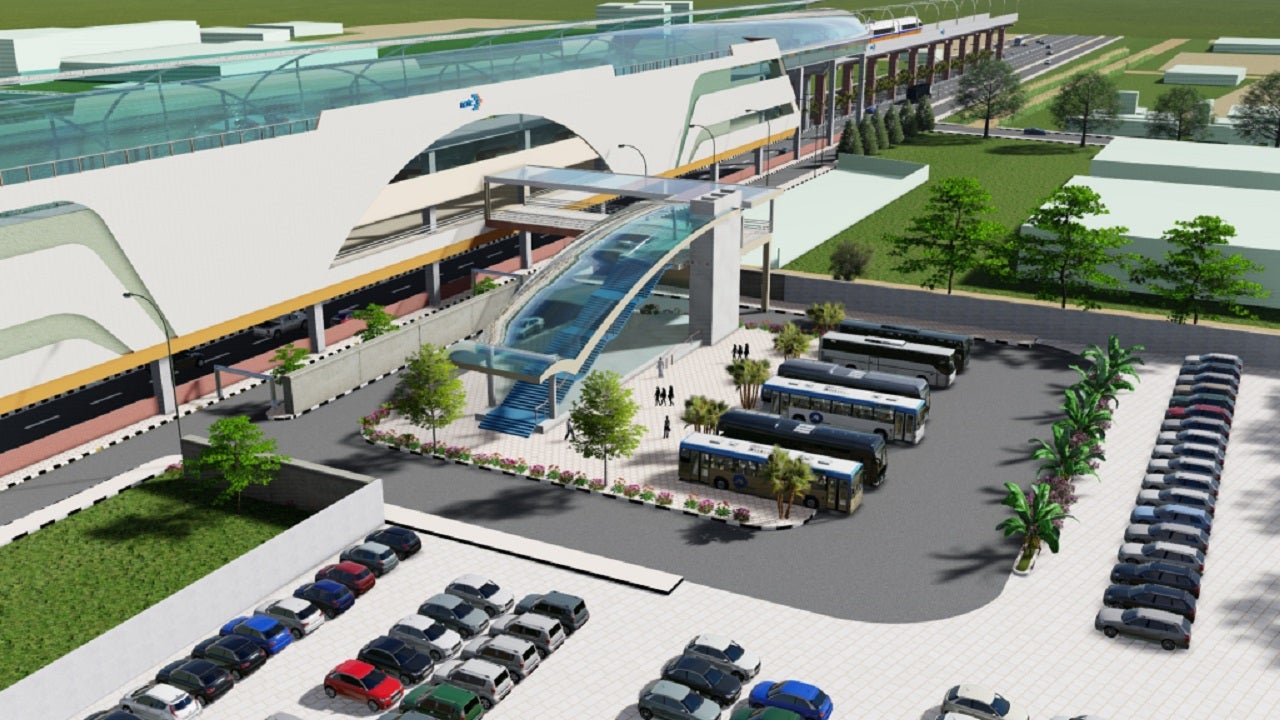
The Delhi-Ghaziabad-Meerut RRTS project will include the construction of an 82.15km-long rapid rail corridor, comprising 68.03km of elevated sections and 14.12km of underground and ramp sections.
The project will link Delhi with Ghaziabad and Meerut in Uttar Pradesh. Approximately 21km of the corridor, with 13 stations, from Meerut South to Modipuram Depot will also be utilised to meet the local transit requirements within Meerut. With a design speed of 180km/h and a maximum operating speed of 160km/h, the RRTS will have high-frequency operations and will cut the travel time between Delhi and Meerut to approximately an hour.
The corridor will have 24 stations, of which 17 stations will be elevated, five will be underground, and two at grade in maintenance depots proposed near the stations at Duhai and Modipuram.
RRTS stations will be integrated with other modes of transport such as railway, metro, and airport. The inter-operable system will eliminate the need for a change of train to move from one RRTS corridor to another. The transit system will feature a standard gauge of 1,435mm with overhead electrified track. Train tracks will be ballastless on tunnels and viaducts while being ballasted in depots.
Pre-construction activities as part of the project included detailed engineering, geotechnical investigations, pile load tests, and road widening.
Rolling stock
The RRTS corridor will initially have trains operating with a headway of ten minutes, which is expected to increase in the subsequent years based on ridership requirements.
Rolling stock will include 30 regional commuter trainsets and ten intracity mass transit trainsets with six and three cars each respectively.
The trains will have a business class coach and a ladies’ coach. Trains and stations will have universal accessibility. Other features will include CCTV surveillance, mobile/laptop charging points, and luggage space.
The aluminium rolling stock will have a width of 3.2m with a two by two seating configuration. Traction power will be supplied by a 25KV AC overhead electric cable.
Signalling and train controlling will be performed via continuous automatic train control system and computer-based interlocking.
Financing
In August 2020, the Asian Development Bank (ADB) approved $1bn in loan for the construction of the Delhi-Ghaziabad-Meerut RRTS. The financing will be undertaken in four tranches between August 2020 and May 2025.
The project secured a loan of $500m from the New Development Bank (NDB) in October 2020. ADB’s Japan Fund for Poverty Reduction will also support the RRTS with a $3m grant for the installation of visual, hearing and mobility aids for persons with disabilities.
The Government of India will provide $1.89bn while the co-financiers are expected to provide $1bn. The Asian Infrastructure Investment Bank (AIIB) is one of the co-financiers of the project.
Benefits of Delhi-Ghaziabad-Meerut RRTS
The Delhi-Ghaziabad-Meerut RRTS will increase passenger ridership in the region and minimise the travel time. It will reduce traffic congestion and kerb vehicular emissions.
It will provide a comfortable and safe mode of transport and boost economic activities through positive changes in travel patterns.
The project aims to decongest Delhi by providing an option for the population of NCR to settle in surrounding cities and being able to travel to Delhi. It will promote social inclusion and development through improved accessibility to places that provide education and job opportunities.
Contractors involved
Larsen and Toubro (L&T) won contracts covering different works, including the construction of two viaducts and a 12km elevated stretch, as well as the manufacture, supply, installation, testing and commissioning of tracks from Sarai Kale Khan to Modi Puram.
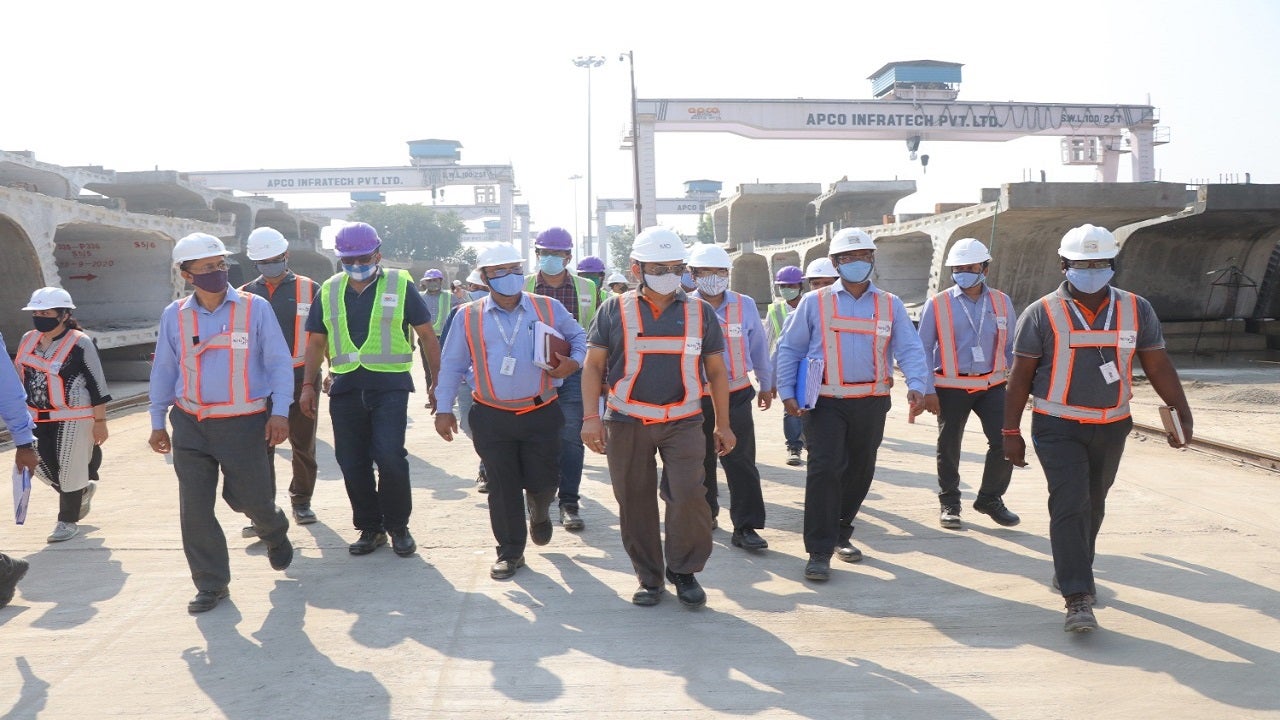
A joint venture of APCO-CRFG was awarded the contract for building a 10.3km-long viaduct as part of the project.
Bombardier Transportation received a $340m contract to supply regional commuter trainsets and intracity mass transit trainsets in May 2020.
The contract will also include 15 years of maintenance services for the rolling stock.
