

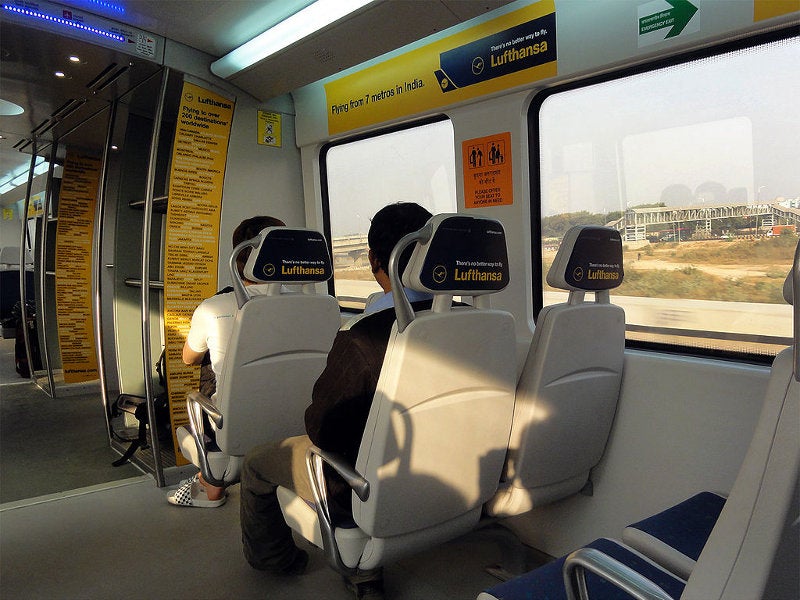
Delhi Metro is the largest and busiest rapid transit system in India connecting the country’s capital region with satellite cities.
The metro system is operated by Delhi Metro Rail Corporation (DMRC), a public sector company established by the Government of India and the Government of Delhi in March 1995. The project was developed in multiple phases. Phase one (65.11km) and phase two (124.9km) are completed, while phase three is currently underway. A phase four is also planned with works expected to begin in 2020.
Recommended Buyers Guides

The Delhi Metro project became the first railway project in the world to be certified for carbon credits for reducing greenhouse gas emissions by the United Nations in 2011. DMRC saved 112.5GW of power by using regenerative brakes in the trains and reduced carbon emissions by 630,000t a year.
Delhi Metro project details
Delhi Metro was conceived to alleviate traffic congestion in the city providing the commuters with a faster and eco-friendly transportation alternative.
Delhi Metro currently comprises a network of 389km with 285 stations and stretches to Noida and Ghaziabad in the state of Uttar Pradesh, and Gurgaon, Faridabad, Bahadurgarh and Ballabhgarh in the state of Haryana.
Construction works to build the rail mass transit system began in October 1998, following more than 40 years of studies. Phases one and two of the Delhi metro were fully-operational by January 2013.
Funding principally came from a Japanese loan and equity infusion by Indian public funds.
Delhi Metro was designed to be integrated with other public transport. DMRC signed an agreement with bus operator Delhi Transport Corporation (DTC) to integrate management and through-ticketing.
In March 2010, DMRC partnered with Google India (through Google Transit) to provide train schedule and route information to mobile devices with Google Maps. The free service allows commuters to get the latest service information and plan their journeys.
Delhi Metro lines and routes
Line 1 (Red Line) runs between Dilshad Garden and Shaheed Sthal (New Bus Adda). The section that runs from Shahdara to Tis-Hazari was opened in December 2002, becoming the first stretch to be commissioned in Delhi.
The line was extended to Shaheed Sthal (New Bus Adda) in multiple stages with the latest section from Dilshad Garden to Shaheed Sthal (New Bus Adda) made operational in March 2019. Line 1 (Red Line) currently runs 34.7km serving 29 stations.
Line 2 (Yellow Line) runs between Samaypur Badli and HUDA city centre. It stretches 48.8km and serves 37 stations. The first section, running between Vishwa-Vidyalaya and Kashmere Gate, was opened in December 2004. Extensions to Samaypur Badli were opened in six stages over three phases.
Line 3 (Blue Line) runs between Dwarka Sector 9 and Noida City Centre. It covers 49.93km and serves 44 stations, and has a rolling stock of 70 trains. The first section of the line was opened in December 2005 and ran from Barakhamba to Dwarka.
Subsequent sections were opened between Dwarka and Dwarka Subcity in March 2006, Barakhamba and Indraprastha in November 2006, Indraprastha and Yamuna Bank in May 2009, and Yamuna Bank and Noida City Centre in November 2009.
The 2.76km section from Dwarka Sector 9 to 21 was opened in October 2010. Operations on the 2.5km extension from Anand Vihar ISBT to Vaishali and Ghaziabad began in July 2011. The section between Noida City Centre and Noida Electronic City became operational in March 2019.
Lines 2 and 3 pass through the city centre and business district at Connaught Place, served by Rajiv Chowk station.
Line 4 ( Blue Line), opened in January 2010, runs between Yamuna Bank and Anand Vihar. It covers 8.74km and includes eight stations, serving as a branch line of Line 3.
Line 5 (Green Line) initially ran between Inderlok and Mundka. An 11.18km section from Mundka to City Park (Bahadurgarh) was opened for passenger services in June 2018. The Green line currently stretches 29.64km with 23 stations.
The 47km-long Line 6 (Violet Line) runs between Kashmere Gate and Raja Nahar Singh. The first section between Central Secretariat and Sarita Vihar was opened in October 2010. The latest extension on the line, from Escorts Mujesar to Raja Nahar Singh (Ballabhgarh), began commercial operations in 2018.
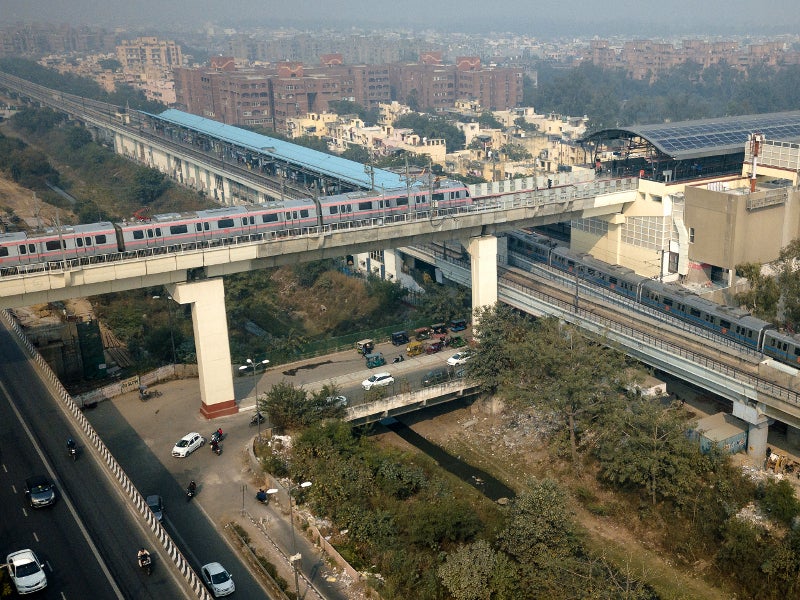
Line 7 (Pink Line) runs between Majlis Park to Mayur Vihar Pocket I. The line was opened in four stages in between March 2018 and December 2018. It now includes 38 stations, of which 26 are elevated.
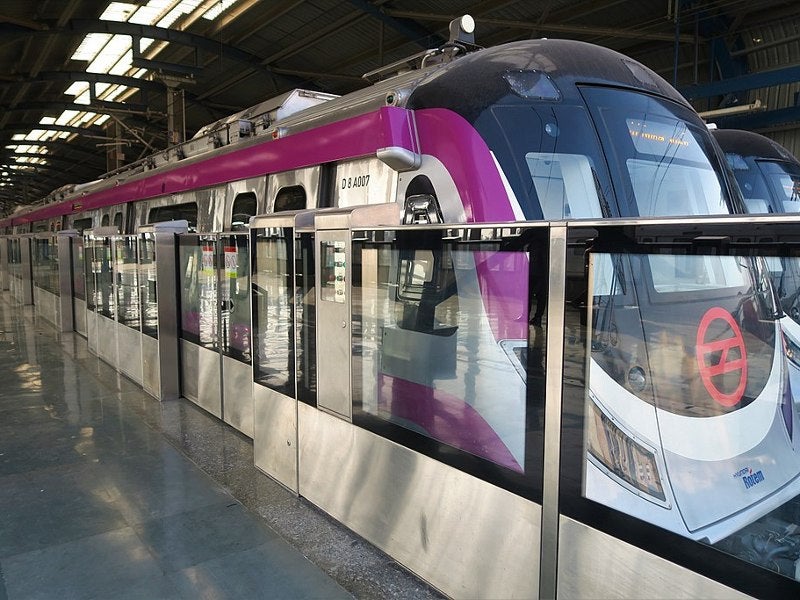
Line 8 (Magenta Line) runs between Botanical Garden to Janakpuri West covering a distance of 38km and serving 25 stations. The line was opened in two stages with the Botanical Garden- Kalkaji Mandir section beginning operations in December 2017, followed by Kalkaji Mandir-Janakpuri West section in May 2018.
Opened in October 2019, Line 9 (Grey Line) connects Dwarka and Najafgarh.
The 22.7km-long Airport Express Line (Orange Line) was opened in February 2011. It runs between New Delhi railway station and Dwarka Sector 21 linking Indira Gandhi International Airport with six stations.
“Lines 2 and 3 pass through the city centre and business district at Connaught Place, served by Rajiv Chowk station.”
Delhi Metro infrastructure
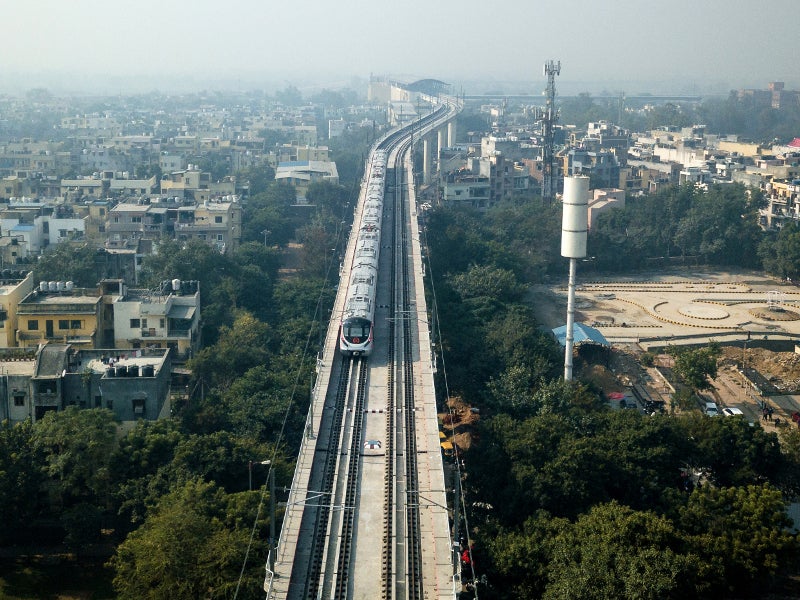
Overall, Delhi Metro system features a combination of underground, at-grade, and elevated stations. All stations have escalators, elevators and tactile tiles to guide the visually impaired from station entrances to trains. Many of the stations are equipped for rainwater collection as part of their environmental policy.
DMRC has also deployed roof-top solar power plants at many stations. In phase one, a total of 58 stations across three lines were built. Another 85 stations were constructed under phase two.
Most of the Line 2 runs underground for its entire length. Most of the stations were built approximately 13m below ground using by cut-and-cover methods. Chawri Bazar, which lies roughly 20m down, needed tunnelling.
The Mandi House station on Line 3 is located under a busy thoroughfare, with much of the station built top-down and the diaphragm wall panels built from ground level to form the permanent walls of the station.
DMRC also provides subway facilities in all the underground metro stations as part of phase two. Bicycle rental is also available at the Vishwa-Vidyalaya, Pragati Maidan, Patel Chowk and Indraprastha metro stations.
Rolling stock for Delhi Metro
Delhi Metro uses rolling stock of two different gauges, namely- broad-gauge and standard-gauge. DMRC currently has more than 300 trains configured into four, six and eight coaches. The inventory includes 2,206 coaches, including 1,296 broad gauge and 910 standard gauge units.
Train depots are located at Khyber Pass, Najafgarh, Shastri Park and Yamuna Bank.
The first set of rolling stock was manufactured by a consortium comprising Hyundai Rotem, Mitsubishi Corporation, and Mitsubishi Electric Corporation. Initial sets were built by ROTEM in South Korea, while the subsequent units were completed in India by the public sector undertaking Bharat Earth Movers (BEML). BEML was also responsible for the manufacturing coaches under a technology transfer agreement.
The air-conditioned trains consist of four 3.2m-wide, stainless steel, lightweight carriages, although eight are possible to be carried. The trains have automatic doors, secondary air suspension and brakes controlled by a microprocessor.
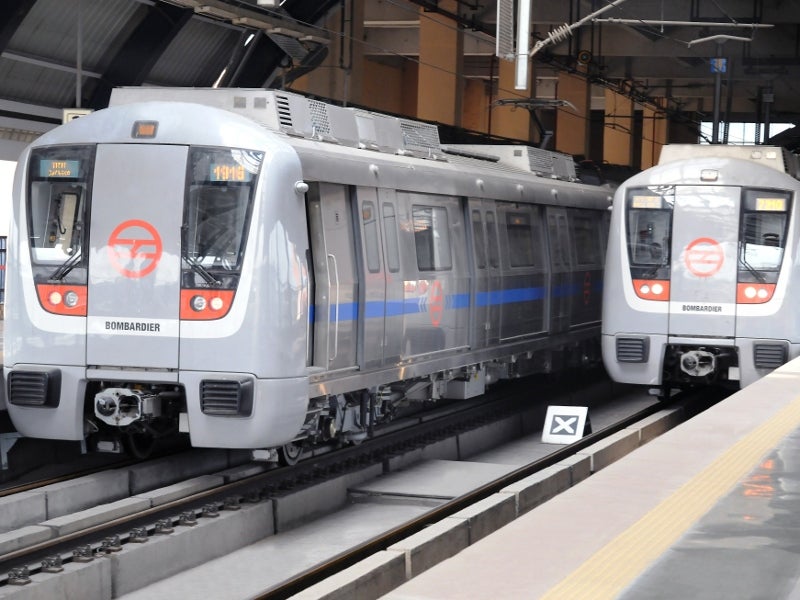
Bombardier Transportation received the contract to deliver the vehicles in the second phase.
Bombardier Transportation announced an €87m ($137m) contract in March 2008 for 84 MOVIA metro cars, a follow-on to an order for 340 placed in July 2007. The new vehicles were deployed as part of the phase two expansion.
Bombardier received a $120m order for 76 additional MOVIA metro cars in September 2011. It was a follow-on contract to an order placed for 114 vehicles in the middle of 2010. Deliveries under the new order were completed in 2012.
DMRC received the first MOVIA metro car from Germany in February 2009. The first 36 vehicles were manufactured in Goerlitz, Germany, while the remaining 388 cars were built at Bombardier’s Indian manufacturing facility in Savli, South Gujarat.
Bombardier delivered the 600th MOVIA metro car to the DMRC in October 2012.
In 2015, Delhi Metro contracted Bombardier to deliver another 162 additional cars, the first of which was delivered in the year that followed.
BEML received a contract worth Rs9.2bn ($205m) from DMRC in May 2011, to supply 136 intermediate metro cars.
Signalling and communications
The trains use centralised automatic train control (CATC) comprising automatic train operation (ATO), automatic train protection (ATP) and automatic train signalling (ATS) systems.
Intercoms are provided for emergency communication between passengers and the driver in each coach, and on-train announcements are in Hindi and English. Route maps and LCD display systems are available in every coach.
Fare collection is through contactless, stored-value smartcards. The metro has its own police force, and a training school at Shastri Park is run in association with Hong Kong MTR for operational and maintenance staff. Security is supported by approximately 5,200 CCTV cameras at stations.
In October 2007, DMRC awarded Bombardier Transportation a $43m contract for the design, manufacture, supply, installation, and testing of signalling equipment. The CITYFLO 350 system was installed on 37km of two of the new line’s sections of the phase two expansion.
The electronic interlocking, operation and automation control systems for the third line were supplied by Siemens Transportation Systems.
Lately, the rolling stock is equipped with microprocessor-based Train Control Management System (TCMS) to monitor the operating condition of the trains.
Delhi Metro: Financing
The capital investment for the first and second phases was $4.11bn. Phase one of the project involved an investment of Rs105.71bn ($1.48bn). Around 60% of the project cost was financed by the Government of Japan by way of a soft loan through the Japan International Cooperation Agency (JICA).
The central government and the state government jointly contributed 28% of the project cost as well as provided a subordinated loan, representing 5% of the total cost, for land acquisition. The remaining 7% of funds were internally generated through property development.
The cost of Phase Two of Delhi Metro amounted to Rs187.83bn ($2.63bn). JICA loan met 54.47% of the project cost, while the central and state governments contributed 16.39% each.
The total estimated expenditure for phase three is Rs410.79bn ($5.76bn).
Delhi Metro: Future expansion and ridership
The ongoing Phase Three, approved in August 2011, involves the construction of more than 160km of network.
The planned Phase Four is expected to add another 103km to the network with 72 new stations. It is expected to be commissioned in 2025.
A phase five expansion is also in pipeline, given increasing population and transport requirements.
As of 2018-19, daily average ridership in Delhi Metro amounted to 2.29 million. The traffic is expected to increase to four million, following the completion of phase three.
