

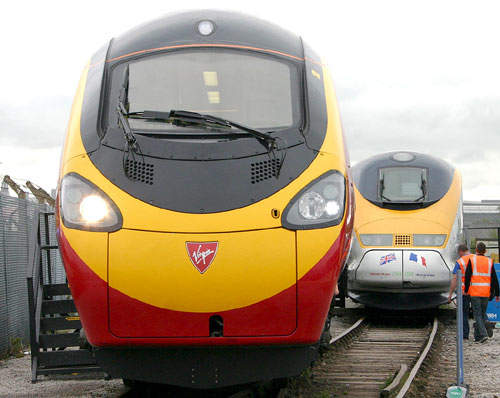
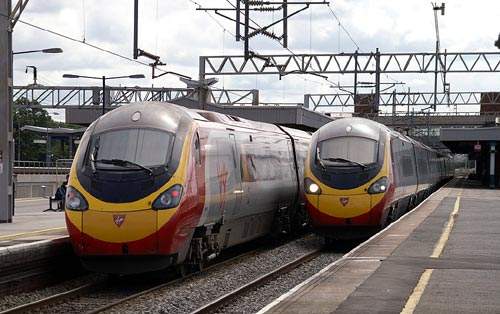
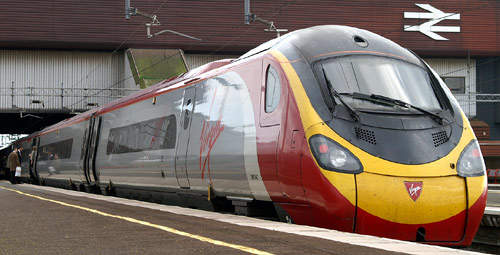
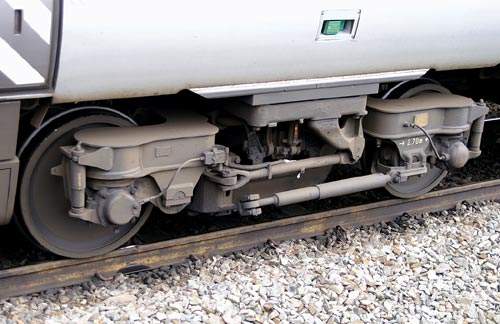

Tilting trains can reduce journey times on conventional track, as opposed to purpose-built high-speed lines such as French LGV or German Neubaustrecke. By controlled tilting in relation to track conditions, centrifugal force that would otherwise cause passenger discomfort is much reduced. With no dedicated domestic high-speed lines realistically expected to be built in the UK, during the 1970s the Advanced Passenger Train was developed with gas turbine and electric variants by British Rail, then the public sector operator of trains and infrastructure.
However, although prototype electric APT sets incorporating a host of innovations briefly entered passenger service on the London-Glasgow West Coast Main Line (WCML), the costs, operational problems and ensuing adverse publicity led to government cancellation of the project.
Recommended Buyers Guides

Incorporating some the powered tilt technology sold to Fiat Ferroviaria of Italy with the already in-hand developments, the company, later to become part of Alstom, went on to create the Pendolino family.
As well as the UK Class 390, other Pendolinos include the Italian ETR 450/460 and 470 Cisalpino; Portuguese Alfa Pendular; Finnish S220 and Czech CD680. The concept remains under development with the later ETR600 for Trenitalia and multi-system ETR610 in testing from 2008 for cross-border Cisalpino services.
The project
Following privatisation under the Railways Act 1993, Virgin Trains won the WCML franchise, inheriting hauled stock and Class 86/87/90 locomotives. With the West Midlands too close to London for high-volume airline competition, Virgin saw service improvements as the key to competing for lucrative business markets to north-west England and Scotland’s central belt, the latter also served by the then more recently modernised and less curve-affected East Coast Main Line.
Upgrading the run-down WCML and the £1.2bn Pendolino fleet order in 1997 was seen as the means of raising standards and giving faster journey times, such as Euston-Birmingham in one hour. Virgin planned for some operating and styling consistencies with the Bombardier-built diesel-electric non-tilt (Class 220) and tilting (Class 221) ‘Voyagers’ originally acquired for their Cross Country franchise, 17 of which were retained by Virgin following the remainder being transferred to Arriva (trading as CrossCountry) in November 2007.
Infrastructure
Including part of the world’s first mainline railway alignment (the London and Birmingham), passing through many urban areas and notably sinuous north from Preston, the WCML lent itself to the gains available from tilt technology. Virgin’s WCML services are from London Euston to Glasgow Central, with intensive schedules on ‘branches’ to Birmingham/Wolverhampton, Manchester and Liverpool.
Using the stock’s 140mph (225km/h) capability required that moving block in-cab signalling would be part of what was effectively a route rebuild, scheduled by the national private sector infrastructure operator Railtrack for completion in 2005, aspects of which were to become heavily amended. Realignments and quadrupling tracks in the Trent Valley section, the first new four-track section of which opened for testing in 2007, will assist in the segregation of Pendolino paths from restored local passenger services (largely withdrawn during rebuilding) and freight flows.
On 23 February 2007, 390033 ‘City of Glasgow’ derailed near Grayrigg, in north-west England. Reported as travelling at around 95mph, the train broke formation with coaches falling from an embankment.
Although there was one fatality and 22 injuries, the crash resistance of Pendolino stock received favourable media coverage. Set 390033 was subsequently withdrawn, exacerbating an already acute capacity problem. A joint Network Rail/Virgin Trains report in September 2007 identified the incident as being caused by faulty Lambrigg 2B points and related poor inspection procedures.
Signalling and communications
Class 390 Pendolinos were designed and wired for the Train Control System (TCS) to allow 140mph operation, on which Alstom worked with Railtrack at the Asfordby research facility in the East Midlands on a 12 mile (19km) TCS-equipped test track. The failure of Railtrack, subsequently replaced by the more government-influenced Network Rail, meant that total WCML upgrading would extend by up to five years; moreover, the projected signalling system was a casualty of cost escalation and the route maximum became 125mph (201km/h).
Electronic advanced seat reservations displays and an in-seat audio system are fitted, with adjacent power supply for passengers’ electronic devices. With four out of nine coaches and a third of its 439 seats allocated to First Class, the original Class 390 configuration illustrated targeting of premium fare and business markets, a service supplemented by designated passenger lounges at principal stations.
Although Wi-Fi is available in these lounges, Virgin did not follow its then ECML competitor GNER (and successor National Express East Coast) with on-board facilities. A subsequent programme to introduce a Wi-Fi service has fallen behind schedule and measures to improve mobile telephone communication on the Pendolino sets have also been required. Consistent with the brand’s operation in other fields, Virgin Trains maintains a high-profile presence through an extensive website and advertising in display, print and broadcast media.
Rolling stock
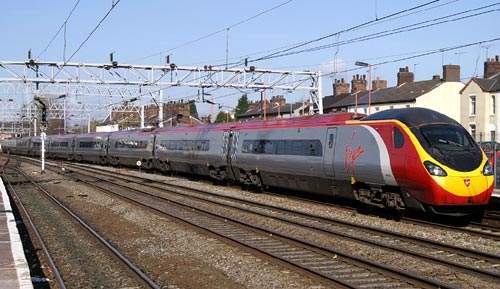
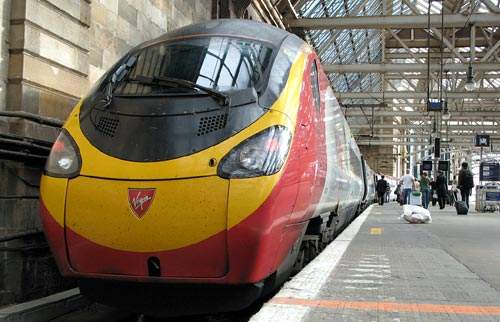
Class 390 is a nine-coach electric multiple unit with a relatively narrow body profile that tapers towards the top to allow for the tilt within the restricted UK clearances. The limited space also has to accommodate the on-board shop, large disability access toilets and the luggage space required by long distance travellers. Overall the in-service success of the Class 390 has increasingly been in conflict with a rise in demand in the UK rail travel market, emphasising the need for more capacity overall on the WCML.
Bodies and much of the equipment were made in Italy. Assembled at Washwood Heath, they became the final rail product of the now-closed former Metro-Cammell site in Birmingham, subsequently closed under Alstom’s rationalisation of their production facilities.
Passenger use began in connection with the 2002 Commonwealth Games, a preliminary to scheduled fleet services starting in early 2003.
Although the maximum speed potential is not currently used nor seemingly destined under any current project to do so, , Class 390 remains the fastest train operating in the UK, apart from Eurostars using High Speed 1.
Concurrent with the current Virgin Trains franchise due to end in March 2012, the fleet is maintained under contract by Alstom (West Coast Traincare) at specialised facilities costing £23m. The main site is at Manchester Longsight, with satellite operations in Glasgow, Wolverhampton and Liverpool. As of 2007, Virgin required 46 serviceable sets to maintain its WCML services.
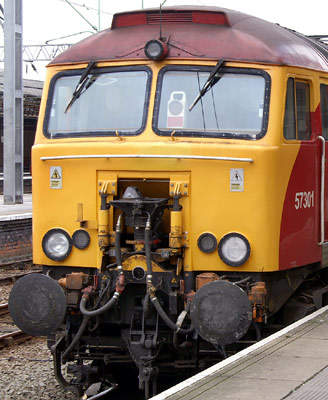
To enable haulage of Class 390 and Class 221 off electrified routes or in event of failures, Virgin maintains a strategically located fleet of Class 57 locomotives fitted with retractable Dellner couplings. In spite of initial teething troubles with the Pendolinos and some adverse comments about passenger space and fare levels, fleet availability has greatly improved and Virgin has enjoyed rising numbers using its WCML operation.
The future
The London to Glasgow route is particularly sensitive to airline competition, with low-cost and established carriers having much capacity to sell on routes between south-east England and Glasgow and Prestwick airports.
WCML was upgraded in January 2009. Raising the route maximum to 135mph (217km/h) is under consideration, partly dependent upon its acceptability given the line’s prevailing signalling and fitting of European Train Control System (ETCS). By 2014, the standard time for Euston-Glasgow could be four hours.
With demand on the WCML showing no sign of slackening, in June 2007 the Department for Transport issued an ‘Invitation to Tender for Service Provider’ covering a complex arrangement whereby a new build of 106 new Pendolino vehicles (representing 7,420 extra seats) will be commissioned and integrated with the existing fleet.
There will be four new 11-vehicle sets for delivery by the end of 2012, and pairs of vehicles deployed to create 31 other such formations from existing sets.
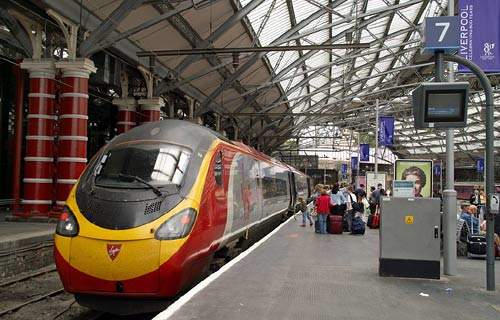
The first one among the four was brought from Italy to Liverpool through rail on a six-month testing programme. The later deliveries are expected to be on schedule. The UK Government proposed a commitment of introducing 2,100 new carriages into the network by 2019.
Proposal for lengthening 31 of 52 existing trains from nine to 11 cars, thereby providing over 7,000 extra seats, has also been approved. Alstom is expected to complete this extension by 2012.
With the process spreading across the end of the current WCML franchise in 2012, two companies were invited to tender; the present operator Virgin Trains and Govia, which runs the London Midland, Southern and Southeastern franchises.
In May 2008 Alstom announced the order to supply and maintain the new vehicles under a €1.8bn (£1.5bn) contract. Owners of the new vehicles will be leasing company Angel Trains, who is also responsible for the current Class 390 fleet.
Virgin is currently operating 53 Pendolino trains. Three new trains and 62 more carriages will be added to Virgin’s fleet in 2012.
Train lengthening will take place at the Alstom Traincare centre in Liverpool. The maintenance contract with Alstom will be extended to incorporate the new vehicles for an extra ten years from the original expiry date in 2012.
In July 2008 the Virgin Rail Group (owned 51% by Virgin Group; 49% by Stagecoach) announced that its Virgin Rail Projects Ltd subsidiary had been selected to bring the new vehicles into service. The group had been in competition with fellow WCML operator (as London Midland) Govia. The new and extended Pendolino sets should be in service by 2012. Alstom’s extended maintenance contract will expire in April 2022.
