

China’s railway system has been going through a massive phase of upgrading and expansion under the Chinese Ministry of Railway’s 2006–10 plan. It has prompted the construction of added rapid transit links in the capital, but in addition high-speed lines are now under construction and development, including the Beijing-Tianjin corridor, as part of a massive project to build 17,000km (10,500 miles) of new railway.
The link between Beijing and Tianjin established a fast corridor between the two major centres, that previously suffered from major road congestion and a slow railway service. The new railway, 115km (72 miles) long, will cut journey times to just 30 minutes, although at the same time the main express road is also being improved. The high-speed link was opened in August 2008 to coincide with the Olympic Games.
Recommended Buyers Guides

One of the early uses of high-speed rail travel in China is the Shanghai airport link, which uses maglev (magnetic levitation) to propel trains along a specially designed track at high velocity.
The project
The Beijing-Tianjin corridor uses conventional railway technology, but is the fastest railway of its kind in the country. Trains run at 300km/h, but the maximum line speed is planned to be raised to 350km/h. A train every three minutes is to be a feature of the new line, with 180 trains per day between the two cities to encourage high-speed commuter travel.
Construction began in July 2005, with a 2007 completion date in mind. Initially, three stations were built and services started from an improved and upgraded Beijing Nan railway station. There are intermediate stations at Yizhuang, Wuging and Yongle.
At Tianjin, the line uses the existing station in the town, which is also used by trains on the Beijing-Harbin and Beijing-Shanghai lines. There will be additional platforms for the high speed
trains.
The new line is being used as the model for future high-speed rail developments in China. French engineering company Systra provided the project management services along with the China Academy of Railway Sciences for the ¥14.3bn ($1.73bn) project.
To assist with funding, the Chinese Ministry of Railways launched a ¥16m railway bond issue in October 2006. This funding was to be invested throughout the 2006–10 network expansion plan, and the Beijing-Tianjin route also benefited from it.
Infrastructure
The tight timescale for the project has resulted in novel construction features. The new line runs on a viaduct for 100km, with just 17km on traditional embankment. This is due to the flat nature of the land surrounding the route. The viaduct is on pre-cast concrete sections for speed, and even the track is based around concrete in a technology transfer agreement with German engineering company Max Bogel. The whole line was laid with 60kg/m rail.
Tto accommodate intensive service of the new high-speed line, Beijing Nan station was redeveloped with five additional platforms specifically for the Beijing-Tianjin line.
For passengers arriving at Beijing Capital International Airport, a connection is made with the express metro at Yizhuang station.
Rolling stock
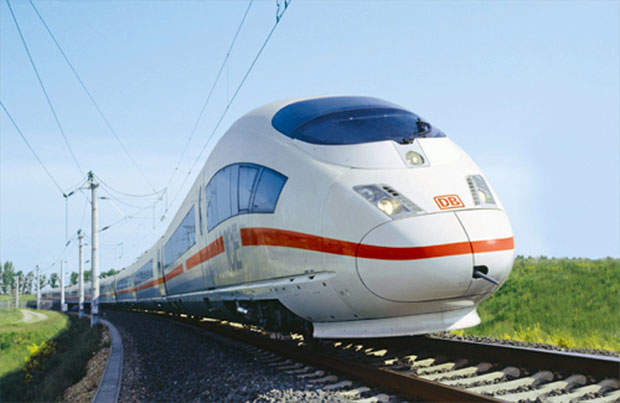
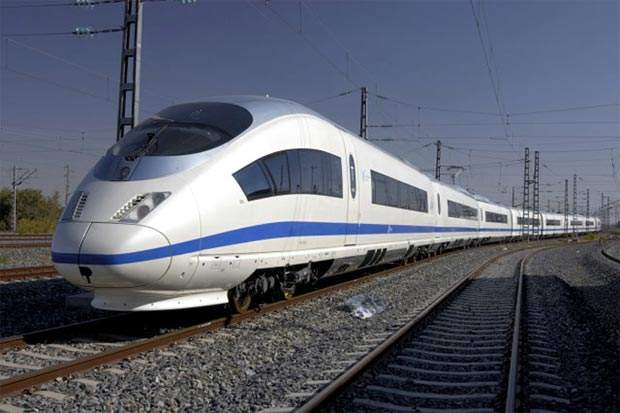
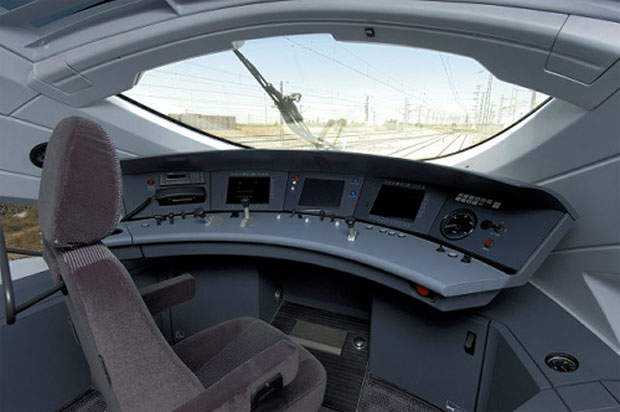
Siemens Transportation Systems has been carrying out the contract for new high-speed trains. They are based on the ICE 3 trains, which are in service with DB (German Railways) and in Spain with RENFE.
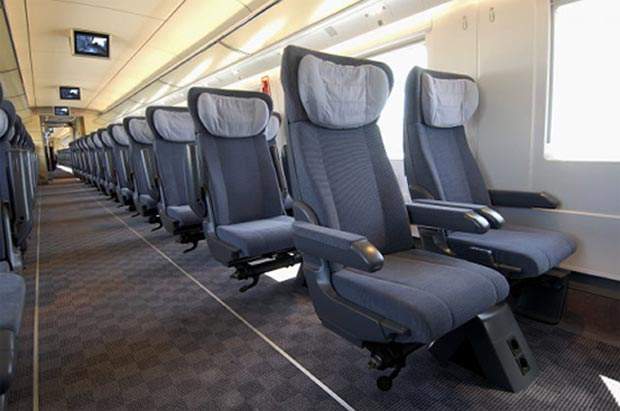
The first three trains were constructed at Siemens’ plant in Germany in October, and in December 2006 production of the remaining 57 sets began in China at the Tangshan Locomotive and Rolling Stock Works. The contract is worth €1.3bn. Each train is capable of 300km/h and each set is 200m long with seating for up to 600 passengers in eight cars.
The new trains have 3,625mm wide bodies – wider than the ICE 3 trains – allowing 3+2 seating to be installed in standard class cars and 2+2 seating in first class. The Velaro CHR3 trains are designed to have a distributed traction package with half of the axles powered and a maximum output of 8.8MW.
To cope with the extreme temperatures of China, the CHR3 trains are being designed to operate in temperatures ranging from -25°C to +40°C. The first new train made its test run on 31 July 2008.
Signalling and communications
The signalling and controlling system of the network includes Simis W electronic interlockings, Vicos operations control system and ETCS Level 1 train control system.
The Ministry of Railways is planning to install a system-wide Chinese Train Control System, which will be designed to be compatible with future developments elsewhere in the country.
The future
An impressive 180 services per day are planned on the Beijing-Tianjin line. Studies were undertaken ahead of opening to determine how much traffic growth can be expected from the route.
Expansion may see a 40km extension from Tianjin to Tanggu, as well a branch line to transport passengers to and from Beijing Capital International Airport.
