



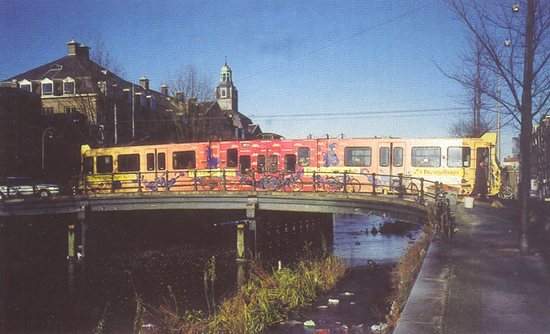
The largest single order for new-generation light rail vehicles was placed by the city of Amsterdam, Netherlands, as part of a major exercise to replace its antiquated fleet of 234 trams, which have become increasingly unreliable.
Trams have been on the streets of Amsterdam for many years, but the city gained its first light rail line in 1977, and the network was subsequently extended during the early 1980s. However, cash constraints meant that the full network proposed at that time could not be completed.
Recommended White Papers
Recommended Buyers Guides

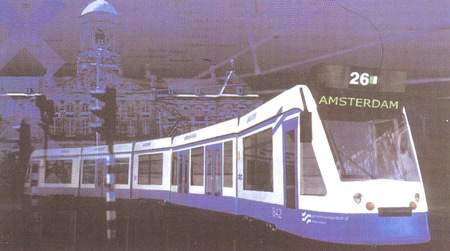
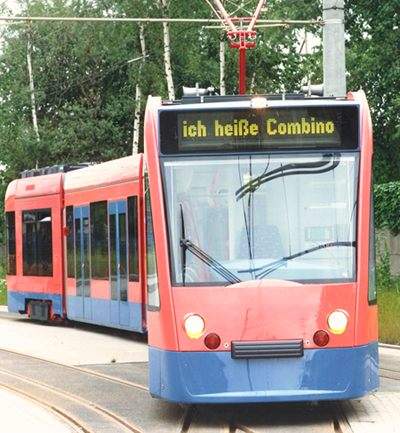
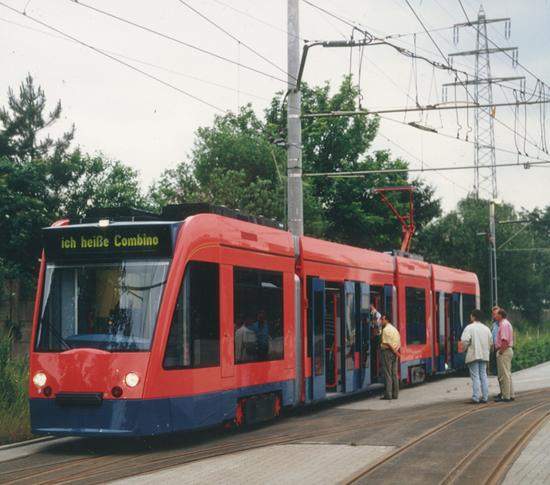
The city now has an extensive combined network of tram and light rail routes. Around 150 low-floor, single-ended Combino Trams and four double-ended Combino Trams entered service between 2002 and 2003, allowing a large proportion of the fleet of antiquated trams to be withdrawn from service. When the order was placed in 2000, almost a quarter were out of service.
Previously under the direct control of Amsterdam City Council, Gemeentevervoerbedrijf Amsterdam (GVB) was awarded a Public Transport Operating Franchise in 2005 ahead of the total privatisation of the Dutch transport systems by 2017. The city has a large interest in ensuring that its light rail system is seen as an attractive form of transport, encouraging people to leave their cars at home.
The project
The metro has four active routes, namely lines 50, 51, 53 and 54. All apart from Line 50 begin at Amsterdam Centraal. A fifth, Line 52, will be operational from 2018.
Lines 53 and 54 connect the city centre to Diemen, Duivendrecht and Amsterdam Zuidoost in the southeast.
Line 51 originally travelled to Amstelveen, but was extended by 2km to Loethoelilaan in September 2004. It is the only hybrid metro track of the four, using shared metro track between Amsterdam Centraal and Zuid and shared tram track onwards. Overlapping stops have dual height platforms.
Known as the ring line, Line 50 connects Amsterdam Zuidoost to the west without passing through the city centre.
Line 52 is still under construction and is scheduled to be completed by 2018. Completion was originally expected by 2012, but the project has been delayed due to lack of funds and criticism from a special city council investigative committee. Underground digging led to the damage of the council’s historic buildings resulting in the increase of the city’s deficit budget.
There are also 16 tram lines in Amsterdam, ten of which terminate at Amsterdam Centraal.
Infrastructure
An important part of the new light rail development has been the construction of a new central workshop facility. However, an independent report released in 2000 criticised its design and productivity. It said the system would be better served if the workshops were closed down, their work was carried out at smaller depots, and the staff was redeployed to help ease acute shortages on other parts of the system.
Most of the metro runs at street-level, but there is a large proportion of reserved trackbed, separated from the street by raised kerbs. A new terminal was completed at Amseterdam Centraal Station in June 2000.
Rolling stock
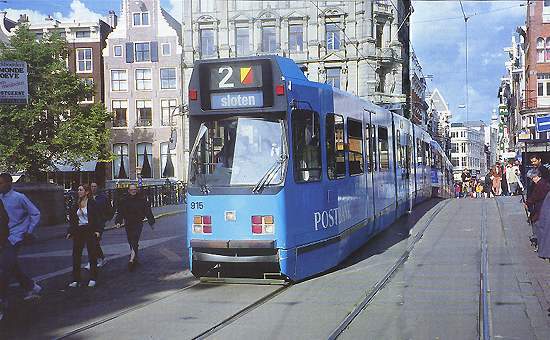
The city runs 236 tram cars of varying ages, and many of the older cars are being retained for use alongside the Combinos on the 16 tram routes.
These operate at a 600V power supply through overhead lines, while the light rail system is supplied through a 750V DC third rail.
The new Combinos consist of five modular sections, with room for 64 and 125 standing passengers.
The first 150 Combinos were built with single cabs, but a further four have driving cabs at both ends. It is possible to couple more than one unit together to create extra capacity.
The low-floor vehicles have a 30cm floor height at the door openings, and the single-level interior is also seen as an important security benefit.
Power comes from four 120kW-rated motors. A central control system governs the operation heating in the passenger saloon, door opening and closing, and a number of other important diagnostic functions.
Signalling and communications
The system is governed by multiple-aspect colour light signals. These are integrated with the road traffic signals for the street running sections.
The Combinos will feature in-cab signalling, giving drivers a reminder of the status of the next signal. This information is received by the train’s ‘nervous system’, which then processes the information and communicates with the central control room by bus links. This means that less wiring is required than conventional signalling lines, offering the prospect of greater reliability.
The driver is also kept informed of the status of the train’s operating systems through the diagnostic circuits, which also store information to help maintenance teams perform their work as quickly and cost-effectively as possible.
The future
Extensions are still being added to existing lines. The first Combinos were initially introduced onto the new ‘supertram’ route running 8.5km from Amsterdam Centraal station to Ijburg, a string of new artificial islands reclaimed from the Ijsselmeer inland sea.
The planned "Zuidas" 9.8km north-south line was due for completion in 2012, but has now been postponed until2018. The cost of the project, oringally budgeted at €1.4bn, has increased by 40% to €3.1bn, making it the world’s most expensive railway line. The line could also be extended to Amsterdam Schipol Airport and Hoofddorp.
A tram line to IJburg in the east, originally intended to be a metro line, was abandoned, and authorities considered converting its tunnel into a chocolate museum. However, the municipality is reconsidering its plans to upgrade the tram line to a metro to connect the expanding city of Almere.
