
Established in March 2002, Network Rail (NR) took over ownership and responsibility for the rail infrastructure of England, Scotland and Wales in October that same year.
Predecessor Railtrack had become subject to damaging criticism, notably over cost escalations, project delays and circumstances surrounding fatal accidents at Southall (1997), Ladbroke Grove (1999) and especially Hatfield (2000).
Recommended White Papers

Recommended Buyers Guides

Losing share value, public confidence and Government support, Railtrack’s effective existence ended with the transfer of assets to NR, by when Britain’s railways were at a mid-point of a ten-year period which had seen passenger levels increase by 40% and freight by 60%.
A private company limited by guarantee, NR members are drawn from the Department for Transport, the rail industry, public organisations and individual members of the public. NR provides track access for train operating companies in the passenger and freight sectors, timetabling and signalling.
More an arm of the state than Railtrack was, NR nevertheless runs as a commercial operation. It can use private sector funding, with any operating surplus re-invested in the network. Main income streams are from track access charges levied on train operators, and commercial operation of the property portfolio.
Network Rail is a separate entity to National Rail, the collective identity of the passenger train companies for purposes of promotion, public timetables and ticketing.
NR is accountable under various statutes, its contracts with customers and suppliers and to the Department of Transport. Since 2004, NR has been monitored relative to targets by the Office of Rail Regulation (ORR), an independent statutory body.
The project
NR states its overall objective as the provision of a ‘safe, reliable and efficient rail infrastructure’. Since 2005, NR has published specific plans for its designated 26 ‘Strategic Routes’, with reference to associated Route Utilisation Strategies (RUS) and other initiatives.
For administrative purposes, NR has an organisation structure founded on eight routes that broadly reflect the coverage of train operating companies. RUS documents concentrate mainly on the means whereby existing infrastructure may unlock potential extra capacity.
NR declared a profit for the first time in 2006, with after-tax profits for 2007/8 reaching £1.2bn. Determined by the duration of the ORR control period, NR published plans for the ensuing two years in their 2007 Business Plan, updated in April 2008.
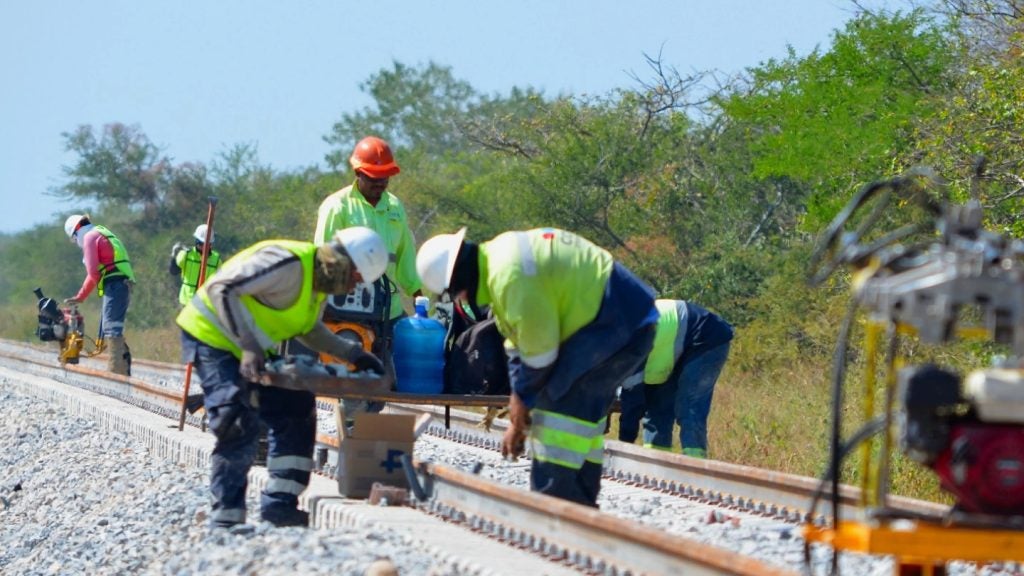
As part of the process of rebuilding a cohesive body of railway skills and knowledge lost in the fragmentation following the demise of British Rail, NR funds £30m of training programmes, including the three-year Advanced Apprenticeship Scheme.
Network Rail has now brought most infrastructure maintenance ‘in-house’, employing its own staff rather than contracting line responsibilities to other companies, and in the process almost doubling its workforce to 32,000. It is committed to reducing controllable operating costs by £43m by the end of the control period.
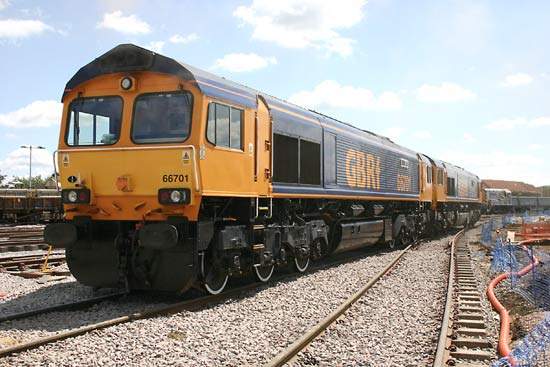
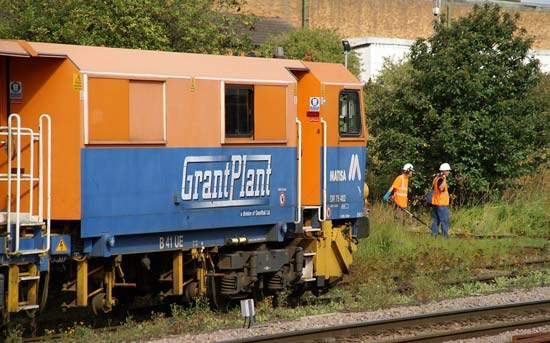
In 2007, NR announced that four main renewals contractors would be retained until at least until March 2009, with GrantRail and Carillion Rail being dropped. Contractors are however used for replacement, new works and for specific projects such as the First GBRf-managed Whitemoor ‘virtual quarry’ yard in Cambridgeshire, opened in 2004.
Rolling stock
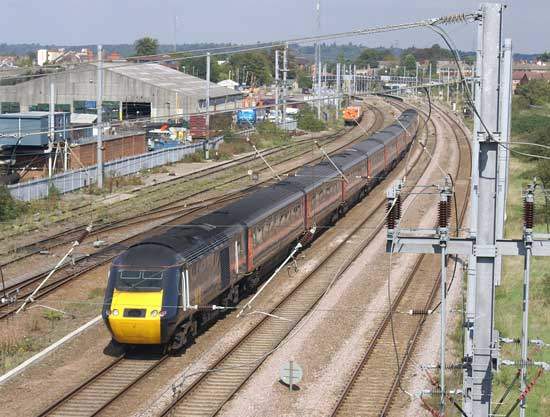
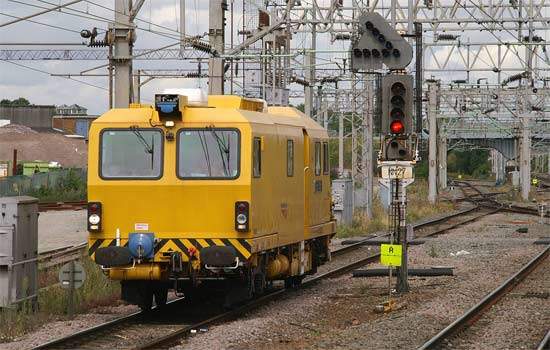
In addition to its specialised track vehicles, Network Rail operates the New Measurement Train, two Class 43 HST power cars with coaches containing equipment to assess track conditions whilst working within train schedules.
It takes approximately two weeks to check the country’s main lines. Vehicles and locomotives such as high route availability Class 31 and Class 73 are hired from other operators.
Infrastructure
The 20,000-plus NR track miles are most concentrated and most intensively used in south-east England, with the West Coast Main Line (WCML) being the busiest route. Areas with long sections of lightly used tracks include the north of Scotland, central Wales and Lincolnshire.
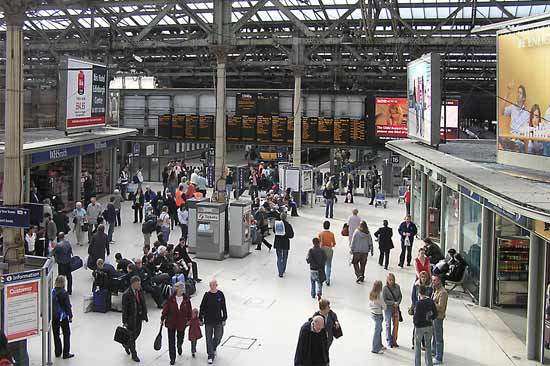
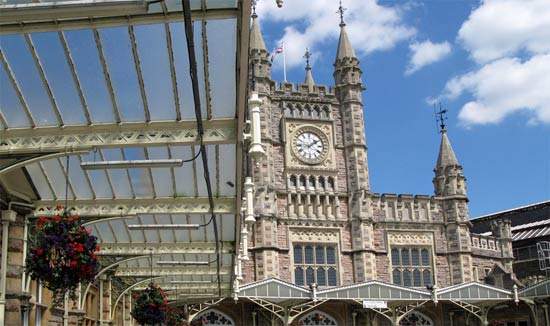
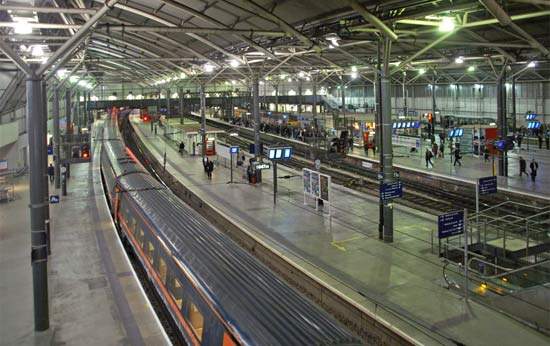
NR owns nearly all of the approximately 2,500 stations on the National Rail network, with most managed by the main train operating company at each station. Seventeen large stations, including most London termini, are directly managed by NR who claim that more than half of all passenger journeys start or end at these stations.
In recent years, major station and track projects were completed at Edinburgh Waverly, Manchester Piccadilly and Leeds. With a high incidence of historically significant structures, properties have to be developed in a sensitive manner yet within the scope of prevailing market requirements and legislation. Parts of the Great Western main line between Paddington and Bristol have been forwarded for inclusion as a UNESCO World Heritage Site.
Unlike mainland European practice, there has been little UK emphasis in recent years on rail electrification. In a break with previous silence on the matter, in 2007 new NR chief executive Iain Coucher expressed support for more of the network to be electrified, a view supported by the Association of Train Operating Companies.
NR’s own figure for new electrification is £800,000 per track mile, something which not only sits in the context of rising diesel costs and environmental issues, but also the extra costs implicit in the complexity of specifications for multi-mode trains (needed to work over unelectrified main lines) in the Intercity Express Programme procurement. Difficulties with the procurement may have caused the bid deadline to be extended to at least June 2008.
Signalling and communications
The network features systems from various eras, including semaphore signals. The original intention to introduce 140mph (225km/h) running on the WCML foundered on the cost escalations and uncertainties of introducing moving block signalling with in-cab signalling.
Expected to be operational by 2013, NR has a £1.2bn project for installation by 2011 of Railway Communications System (GSM-R) to improve general information transfer and raise safety levels.
The future
For the three years up to 2009, NR will be spending £400m on small to medium projects. For the biggest projects, the basic framework within NR operates are defined by Government as enshrined in the ‘High-Level Output Specification’ and the 2007 white paper ‘Delivering a Sustainable Railway’.
The forthcoming main projects are Thameslink, the station areas at Birmingham New Street and London King’s Cross, track layouts at Reading, Basingstoke and works in connection with 2012 London Olympics.
The ORR rejected NR’s request to extend the WCML upgrade timetable to May 2009, and its main elements should be complete for the December 2008 timetable changes. Gauge improvements continue on freight corridors as part of projected 30% freight growth over a decade by 2016 (240 extra trains per day).
In the longer term, NR will be absorbing new infrastructure resulting from the Crossrail project due to start operations in 2017.
New year 2008 brought bad news for NR, with track possession over-runs, staffing problems and ensuing criticism by train operating companies making national headlines.
Subsequent problems included the ORR ordering NR to cut their operating costs, fines for over-runs (with this ‘book’ transfer of funds between public bodies itself attracting adverse publicity), continuing disruptions with the long-running WCML upgrade and uneasy relationships with train operating companies.
With delays and road substitutions a recurring problem, NR has pressed for extra funding to make possible their ‘move towards a seven-day railway’ whereby freight and passenger customers would experience far less disruption.
In spring 2008, NR announced that train punctuality had reached new heights, with 89.9% arriving on time for the year 2007/8.
By April 2008 this had exceeded 90% for the first time ever, in a context of there being 25% more trains running than at the privatisation of the UK’s railways in 1995.