
Bremen in north-west Germany is one of the two urban subdivisions, the other being Bremerhaven, that make up the country’s smallest land (state), Freie Hansestadt Bremen.
A historic port 60km along the river Weser from the North Sea, the thriving city of Bremen’s economy embraces aerospace technology, vehicle manufacture and foodstuffs.
Recommended White Papers

Recommended Buyers Guides

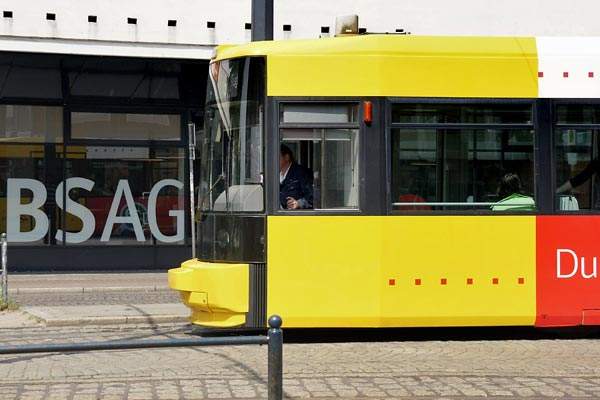
Busy with freight traffic, Bremen is also a focal point for passenger regional rail and enjoys frequent Deutsche Bahn IC and ICE services. Urban transport is the responsibility of Bremer Strassenbahn AG (BSAG) whose operations are included in the Verkehrsverbund Bremen Niedersachsen (VBN) for ticketing that extends beyond Bremen itself.
The project
As a transport and manufacturing centre, Bremen had been a prime bombing target during World War II. The tram system was split by the destruction of river bridges, with only 20% of infrastructure was undamaged and 10% of rolling stock in working order. After a few months total closure, the system was restarted in 1945 and piecemeal restorations were made, albeit with route closures that continued until the 1960s.
In 1990, the governing authority adopted a transport masterplan, which acknowledged the importance of trams in city transport. Eight years later, the first tangible signs of the plan appeared, with the opening of a revamped Line 4, complete with a 3.4km extension to a new northern terminus at Horn-Lehe.
Costing DM64m, this replaced several bus routes, with buses instead acting as feeders, connecting outlying areas with trams.
A 1.6km extension of Line 6 to the airport was completed in May 1998, notable for the very close proximity of the tram stop to the terminal, subsequently extended to create a low-cost operator hub from 2007 with an attendant increase in passengers.
Line 6 also now serves the main university, following the opening of a 2.2km extension in October 1998.
Infrastructure
The 1,435mm 750v DC overhead supply system has tram turns at termini and accordingly the fleet is single ended and with doors on one side only. There are eight lines, with three related ‘Schnell-Linie’ (limited-stop express routes) and three tram routes in BSAG’s ‘Nachtlinien’ (night network). The focal point of the system is at the multi-platform interchange immediately outside Bremen Hauptbahnhof, with Domsheide being the main interchange between lines in the city centre.
Currently, trams share the road with other vehicles over parts of the system, but plans envisage more dedicated trackbeds, physically separated from other existing rights of way. There is a mix of grooved rails and railway-type tracks with some grassed sections. BSAG’s operational headquarters and a maintenance workshop are at Flughafendamm by Line 6 near the airport.
There is another depot at Gröpelingen, a terminus of three tram routes and important bus interchange for connections to the Bremen-Nord community further along the Weser’s right bank.
Rolling stock
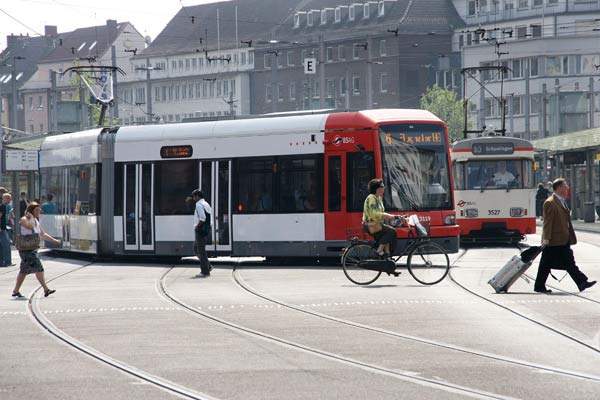
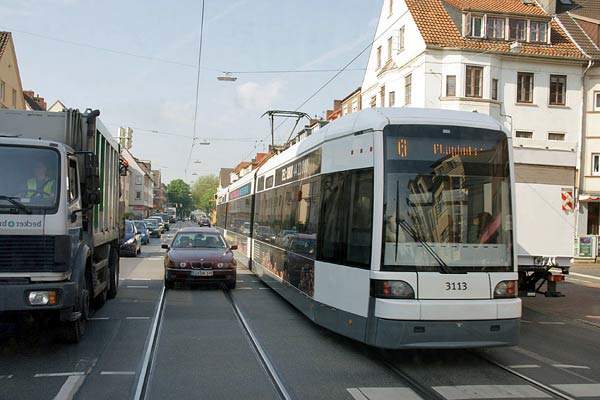
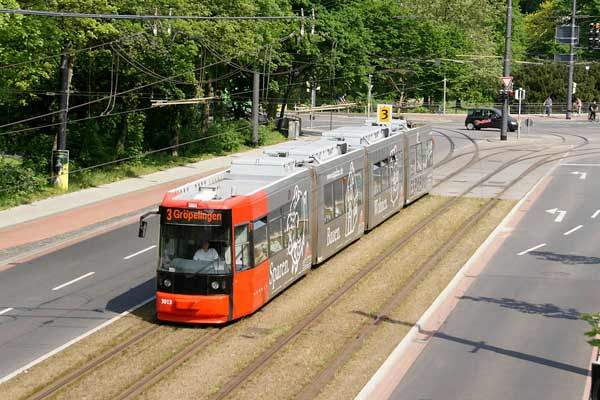
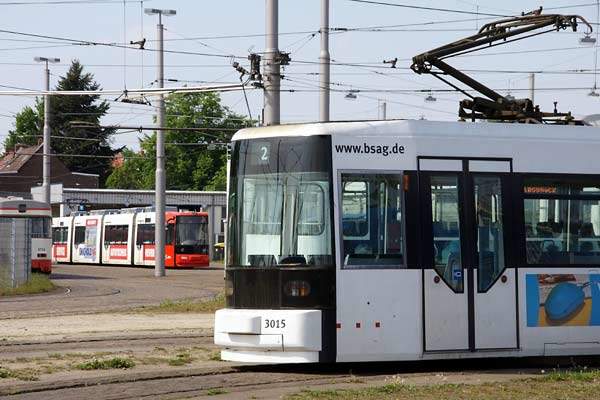
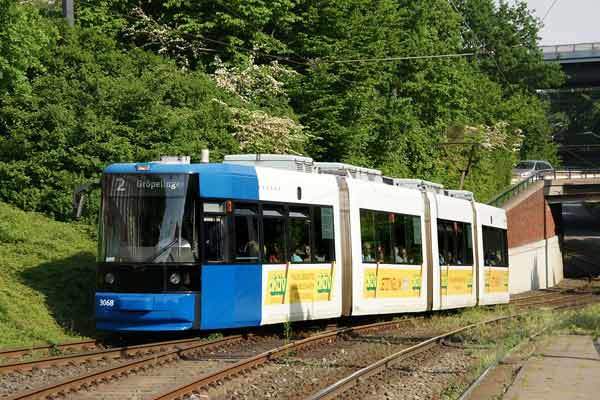
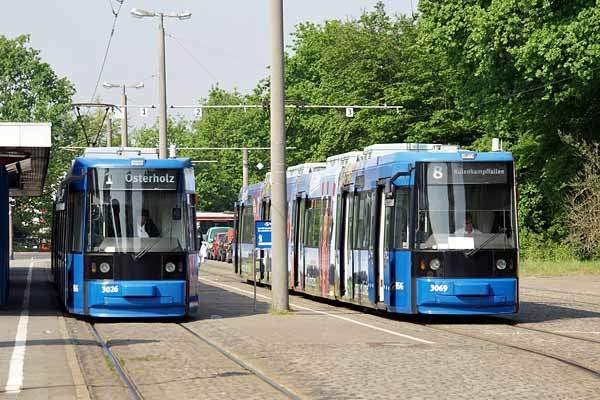
Bremen was at the forefront of operating low-floor bus services and was to become so with trams. A light rail vehicle, type GT6N, was delivered to Bremen in 1989 by Bayern-based constructor MAN. As well as use in Bremen as No. 3801, the tram was used for demonstration in other cities. Later sold for use in Norrköping in Sweden, this prototype led to a new fleet of GT8N 78 four-element articulated vehicles. With the type becoming the largest part of the BSAG tram fleet, numbered in the 3001 series and built 1993–96, the order was placed with AEG (later Adtranz).
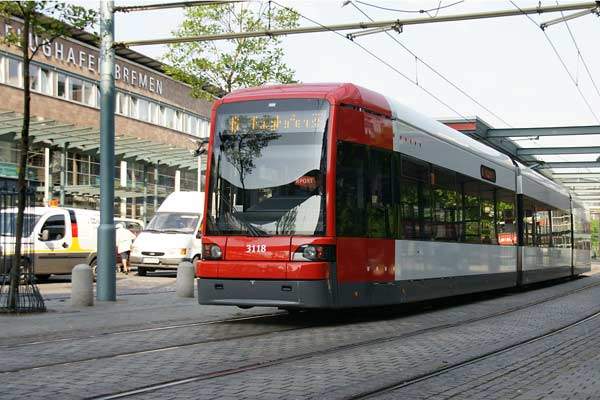
BSAG later ordered 20 three-element 8NGTW Flexity Classics from Adtranz successor Bombardier, numbered from 3101 and built 2005-07. With a capacity of 241 (106 seated), the 35.4m trams feature 74% low floor, 2.65m-wide bodies (the earlier GT8N being 2.3m), have air conditioning and lift facilities for disabled passengers.
These were delivered in 2009. The railway authority ordered nine more GT8N-1 light rail systems in 2011-12.
Although older high-floor stock is being withdrawn, with some sold on to other users, GT/GB series trams and trailers built by Wegmann of Kassel mainly dating from 1976 remain in front line service.
Signalling and communications
Colour light signals govern all movements, with integration with road signals at the many places where the two systems meet. Especially important for the intensive services in the central city area, stations are equipped with real-time LED displays advising passengers of the next departures and their destination.
As per the German norm, the many ticketing options range from single trips to VBN coverage; the network also being covered by the DB Niedersachsen-Ticket which includes Bremen state. A high-profile operator in general, BSAG maintains a comprehensive service website that includes a large English section.
The future
Substantial expansion plans exist for rail-based transport in the area, with central government identified as funding 60% of new developments, the remainder from more local public funds.
Bringing a new catchment of 15,900 to the tramway, Line 1 is to be extended 3.5km from the present Roland-Center terminus to Brussels Street. Subject to permissions given, building should begin in 2010 for a late 2012 opening.
From Roland-Center will be an 11.1km Line 8 extension to Leeste. Due for a 2011 opening, this would use part of the Bremen-Thedinghauser Eisenbahn (railway) line and, with a common gauge between the tramway and heavy rail, may involve the use of hybrid tram-train vehicles. This extension is yet to be completed.
Other projected extensions are of Lines 2/10 and the long-standing plan to link the town of Falkenberg to Bremen via Lilienthal and the current Borgfeld Line 4 terminus.
An extension of Line 1 from Bremen-Osterholz to Bremen Mahndorf is under way. It is expected to be completed by 2013.