
From being in peril of large-scale closures at the start of the present century, the passenger-only railway network of Northern Ireland continues to undergo a resurgence that mirrors the fortunes of this constituent country of the UK.
Unlike the national rail operations elsewhere in the UK, operating body Northern Ireland Railways (NIR) is not subject to franchising arrangements and remains wholly within the public sector.
Recommended White Papers
Recommended Buyers Guides

The project
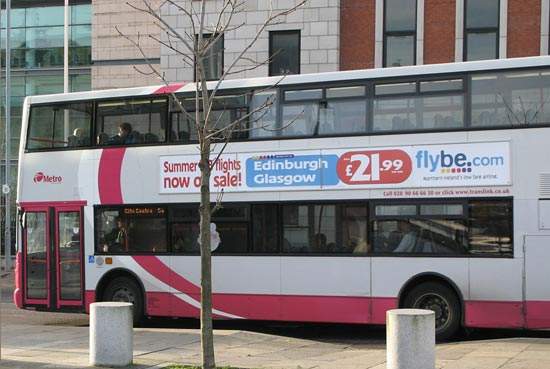
Ultimately controlled by the Northern Ireland Assembly and part of a public corporation, the Northern Ireland Transport Holding Company (NITHC), NIR is one of three public transport subsidiaries along with Metro (the principal Belfast bus service) and Ulsterbus. Operating under the Translink identity, the group’s purpose is to provide bus and railway services within and to/from Northern Ireland, with an underlying objective of service coordination and integration.
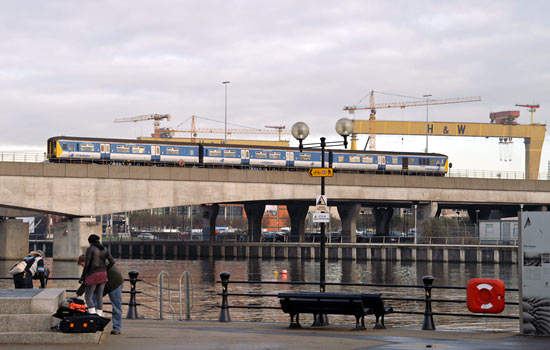
Many years before Northern Ireland was to attain civil stability, a promising sign for the future of railways had been the opening of the Dargan railway bridge across the River Lagan in 1994. Combined with the 2001 reopening of the Antrim-Bleach Green line, it effectively shortened timings to all stations north of Belfast.
Paradoxically, however, these infrastructure improvements highlighted the fragility of the system. West of Belfast, the Lisburn-Antrim line that had been the previous link to the north lost its services, mothballed due to a funding shortage.
As late as 2004, fears were being voiced by politicians about the full survival of the Larne line, similarly with any parts not designated as being in the ‘core network’.
With subsequent track rebuilding and stock renewal, Northern Ireland’s railways appear to have a much better future than previously. However, developments have yet to gain the momentum of those over the border under the ambitious plans of the Irish government’s Railway Procurement Agency.
Infrastructure
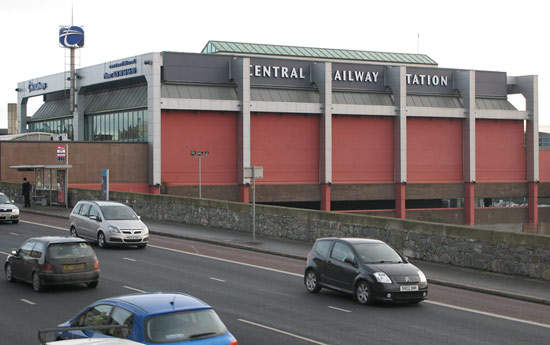
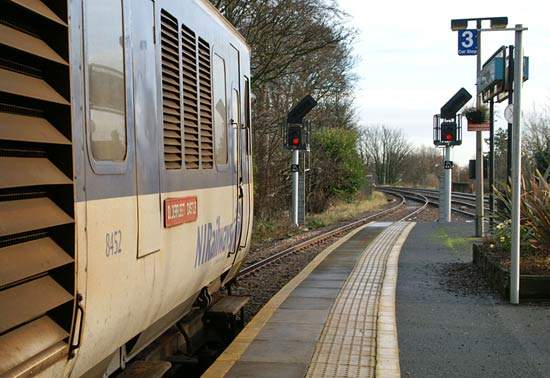
Using the 1,600mm gauge common to NIR and IE, Northern Ireland has six designated routes, all except Portrush-Coleraine at some point serving the capital city of Belfast. Much improved by rebuilding to install better passenger facilities, Belfast Central has the greatest concentration of services. Stations across the network are subject to a rolling programme of improvements to increase the appeal of using rail including lighting, signage, access and platform surfaces.
First opened in 1994, under a £2.5m project completed in January 2008, the system’s York Road depot beside the Larne/Antrim line in Belfast has been modernised and extended to handle the transition in rolling stock. To maintain stock availability, around half of the depot’s work takes place overnight.
Its far-from-central position is offset by free onward bus travel to the centre of Belfast for holders of valid rail tickets. There are also frequent services from Great Victoria Street station in the city centre, including those on the key commuter route south towards Portadown and Newry.
Although subject to official enquiry following drastic cost overrun, project delay and a cutback of the original specification, passenger number increases on the rebuilt Bangor-Belfast line demonstrated the appeal of faster and more frequent services by modern rolling stock. Similarly, Carrickfergus on the upgraded Larne line has a twice-hourly Belfast service, albeit still with older stock. Loadings for NIR overall increased by 34% between 2002 and 2006. For 2007–8 there were 9.5m rail passenger journeys made on NIR, a 12% increase over the previous year.
Rolling stock
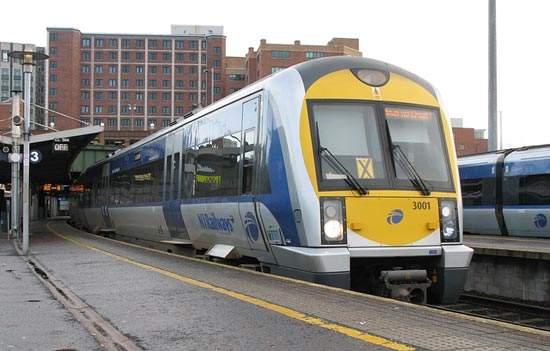
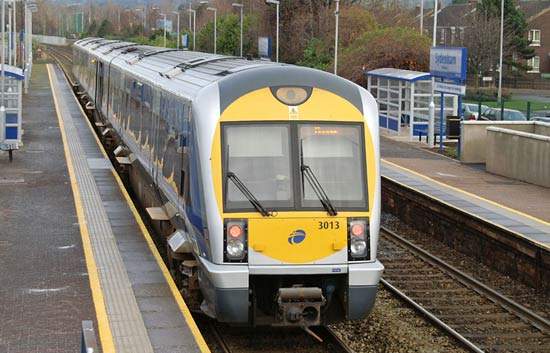
Representing the system’s revival is the 3000-class (C3K), now NIR’s largest passenger fleet. Involving a funding contribution from the European Community, the trains were part of an £80m investment in NIR approved by the Northern Ireland Assembly in December 2000.
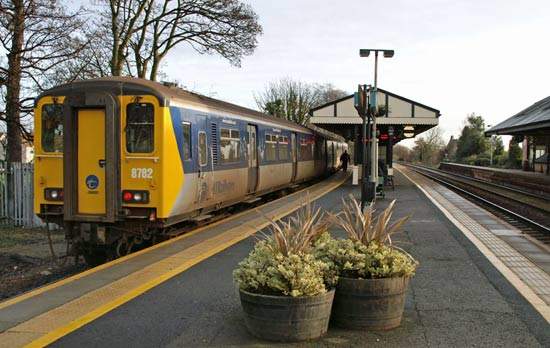
The 23 three-car diesel units were supplied from 2004 by Spanish company Construcciones y Auxiliar de Ferrocarriles (CAF). These have substantially raised the standards of passenger accommodation over the DMU types they have largely replaced, classes 80 and 450.
With internal refurbishment of the surviving examples, the latter are retained to work Belfast-Larne services.
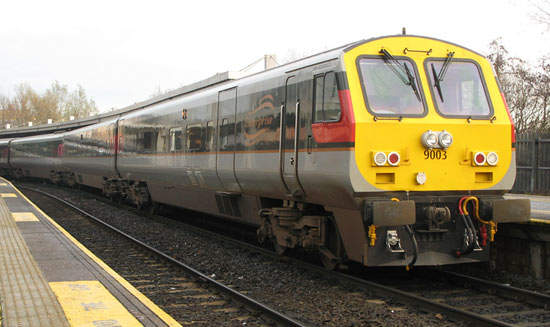
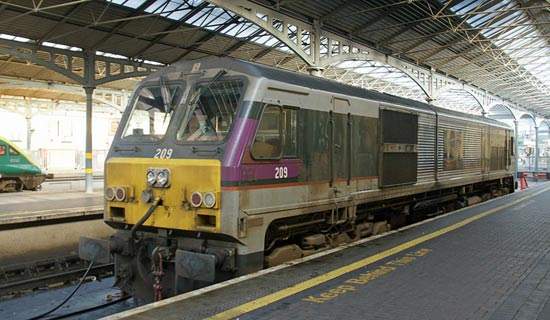
The principal remaining loco-hauled passenger services relate to NIR’s share (with Irish operator Iarnród Éireann) in the Belfast Central-Dublin Connolly ‘Enterprise’ service.
These use dedicated three rakes of push-pull stock from De Dietrich, maintained by NIR in Belfast, powered by Class 201 diesels (two belonging to NIR), all maintained by IE.
Signalling/communications
Automatic Warning System (AWS) is standard on NIR, with some Train Protection Warning System (TPWS) installation. Signalling systems have been part of the upgrading projects for lines like those towards Bangor and Larne.
Although the entire class is cleared to operate with restrictions in Ireland, some of the C3K units have been fully fitted with the Continuous Automatic Warning System (CAWS) and IE communications equipment.
The future
Contrary to the NIR’s main operations, which have enjoyed greatly increased passenger numbers following recent investments, the Enterprise service has had dips in patronage over several years, albeit reported stabilised by 2007. Affected by security-related problems and high equipment failure rates on scheduled 2h10min timings, in practice the Enterprise has not proven sufficiently competitive in the face of road-based alternatives.
Mindful of the symbolic cross-border link and with both governments keen to encourage road use, the stock is to be upgraded and more promotional pricing has been introduced.
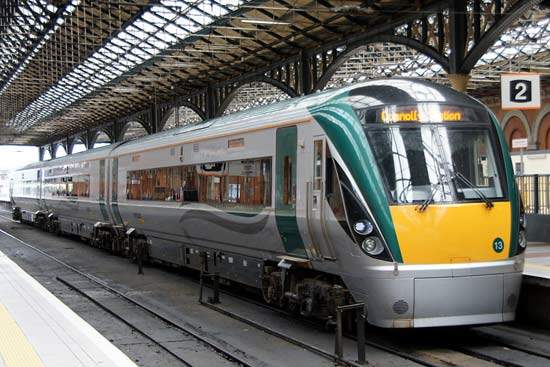
A doubling of frequency to hourly is being considered now officially considered as being instrumental in improving patronage. To provide this increase to be delivered by NIR in association with IE may involve C3K or similar modern multiple unit stock such as IE’s Intercity Class 22000 delivered from 2007.
In June 2008 Translink published the documents to invite tenders for 20 more C3K/equivalent trains, the schedule indicating signing with the supplier by March 2009. First deliveries are expected in 2011, with last entering service in 2012. Deployment of the C3K/equivalents should see withdrawal of earlier generation DMUs.
With spending restrictions lifted on the Belfast to Derry line (also termed Londonderry, Northern Ireland’s second city), a business case is being prepared for relaying and resignalling, plus installation of passing loops to remove the main obstacles for shorter journey times (by up to 30 minutes) and more frequent services.
In June 2008 the Regional Development Minister announced that £86m would be invested over five years up to 2013 in Derry line infrastructure and (from the forthcoming order) two extra train sets. The section between Derry and Coleraine will be completely relaid and overall Derry-Belfast timings will reduce by around 30 minutes.
If NIR continues to increase passenger numbers and gets sustained funding, there is a possibility of restoring the 20-mile Lisburn-Antrim line, adding a new station to serve Northern Ireland’s main airport, Belfast International (Aldergrove), and to complete a circular rail route.