
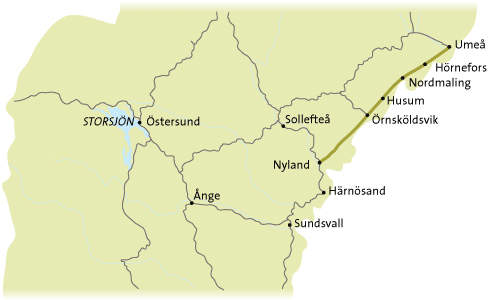

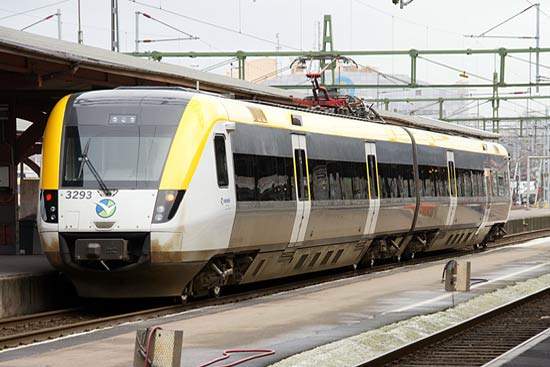
After several delays including legal challenges, the 190km (118-mile) 1,435mm gauge Botniabanan mixed-use high-speed line from Nyland to Örnsköldsvik and Umeå in north-eastern Sweden opened in August 2010
An agreement was signed in November 1997 between the Swedish national government and the regional governments to create the new Botniabanan, a direct route that would also give better links to a chain of towns along the Gulf of Bothnia. It would also provide relief for an existing trunk line, which is restricted by its winding single-track formation and severe gradients.
Recommended White Papers
Recommended Buyers Guides
The line opened up new journey opportunities for passengers and promoting regional development. It also improved this section of track, which is part of a link to the networks of Russia, Finland and southern Sweden.
Now in the context of an upsurge of rail use in Sweden, the project has the added dimension of improving a continuous rail connection with the rest of Europe via the Øresund fixed link to Denmark. This now extends onwards into Germany via Great Belt crossing and in future through the more direct Fehmarnbelt fixed link project.
To finance, plan, build and manage the SEK32.2bn railway, a new company, Botniabanan, was set up by the Swedish state (which owns 91%) and the regional governments of Kramfors, Örnsköldsvik, Nordmaling and Umeå (9%).
The project
After extensive public consultation, construction work formally started in August 1999 with an initial view to completion as early as 2006. Journey times between Stockholm and Umeå were reduced from nine hours to around five-and-a-half hours and a four-hour coach journey from Sundsvall to Umeå was reduced to a two-and-a-half hour train trip.
Responsible for financing, detailed design, procurement, construction, commissioning and leasing, in concert with contracted companies Botniabanan has built the line in accordance with Swedish Rail Administration Banverket regulations for approval, open access and access charges.
The northern half, from Ornskoldsvik to Umeå, is the only section operating during the initial years. Traffic to the south, between Ornskoldsvik and Ådalsbanan is yet to begin. The operations on this section have been delayed until mid 2012 due to ERTMS signal system installation on the line.
Banverket will take over responsibility for the line and lease it to Botniabanan until the investment is paid off, whichis expected to be 2050. Thereafter ownership of the line will transfer to Banverket.
Infrastructure
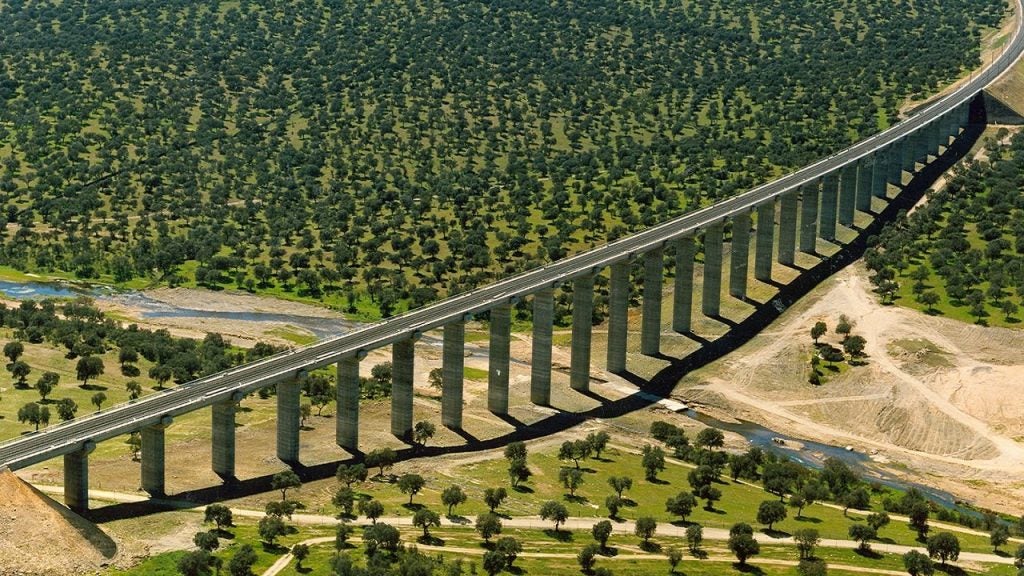
Over its 190km (118-mile) length made up of mainly single line with passing loops, the Botniabanan crosses difficult terrain requiring 140 bridges, 25km (16 miles) of tunnels (with escape routes every 500m) and the excavation of 8 million m³ of rock and 8.7 million m³ of earth. At the western end in particular, several long tunnels are required, including the 6km (3.7-mile) Namntallhojden and the 5.2km (3.2-mile) Bjornboleshojden tunnels.
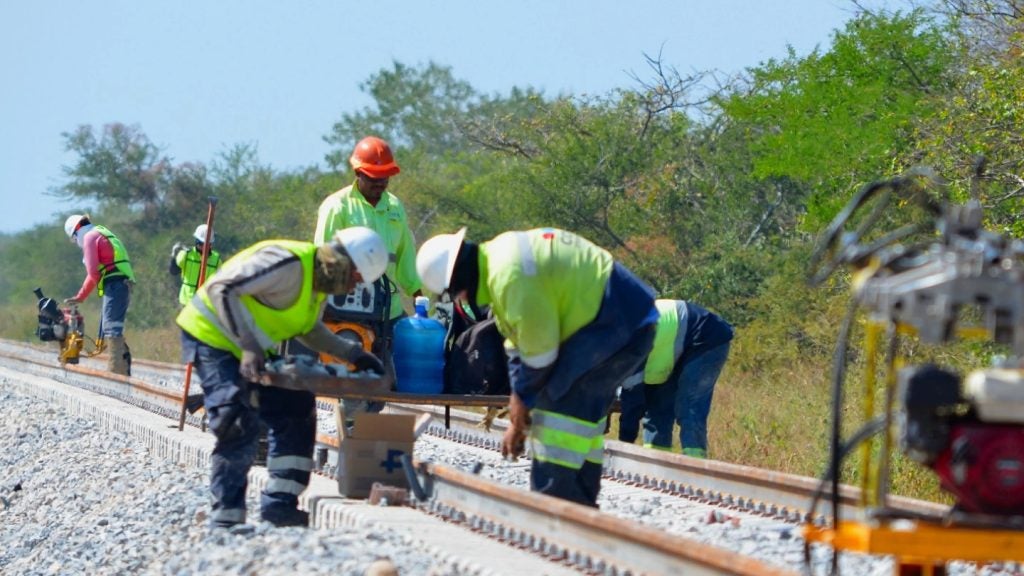
Around 130 contracts were let by Botniabanan for the project, including ones to Balfour Beatty Rail, Sweden, and VR Track, Finland, for track laying, and to Banverket’s Industrial Division for electrification work.
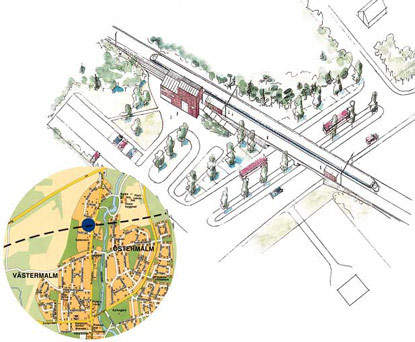
Six new stations were built for regional traffic at Örnsköldsvik North and Umeå East and for all trains at Örnsköldsvik Central, Nordmaling, Husum and Hornefors. In addition, Umeå Central station was rebuilt to act as a regional hub and interchange between regional and express trains, buses and other forms of transport. A major consideration for the builders was the need to meet stringent demands in this sensitive area.
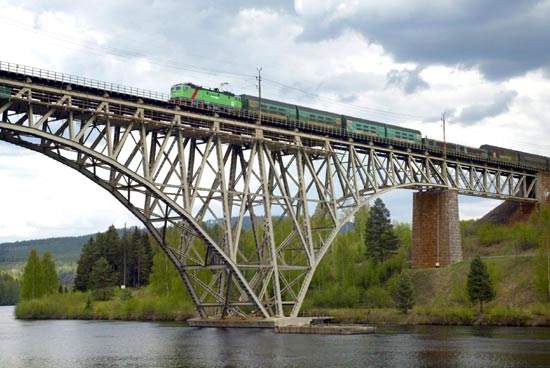
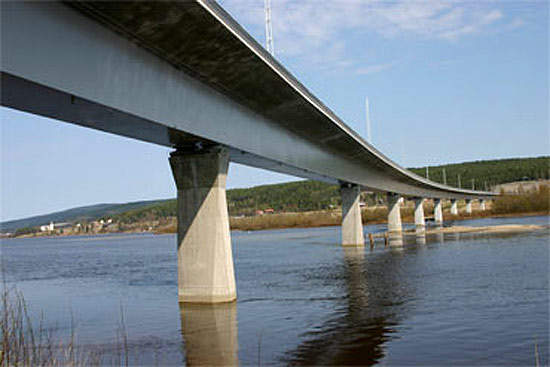
This has been particularly felt in the planning and construction of three of the longest bridges on the line – the 1.04km (0.64-mile) bridge over the River Angermanalven, near Kramfors Airport, the 480m span over Lake Offersjon, 10km (6.2 miles) further north, and the 965m bridge over the River Natraan, near Bjasta.
The line is electrified at the Swedish standard of 15kV AC overhead supply to enable through running from other Banverket lines. Power is supplied by 20 3MVA autotransformers supplied by Balfour Beatty Rail.
Overhead lines are suspended from 3,200 masts, with track supported on 320,000 sleepers and held in place by 1.2 million Pandrol fastenings.
The axle load has been increased from the old line’s 25t to 30t, and the maximum gradient will be 1%. Curves are to a minimum radius of 3,200m, except through Örnsköldsvik where the route of the line and surroundings dictate 600m radius curves.
Rolling stock
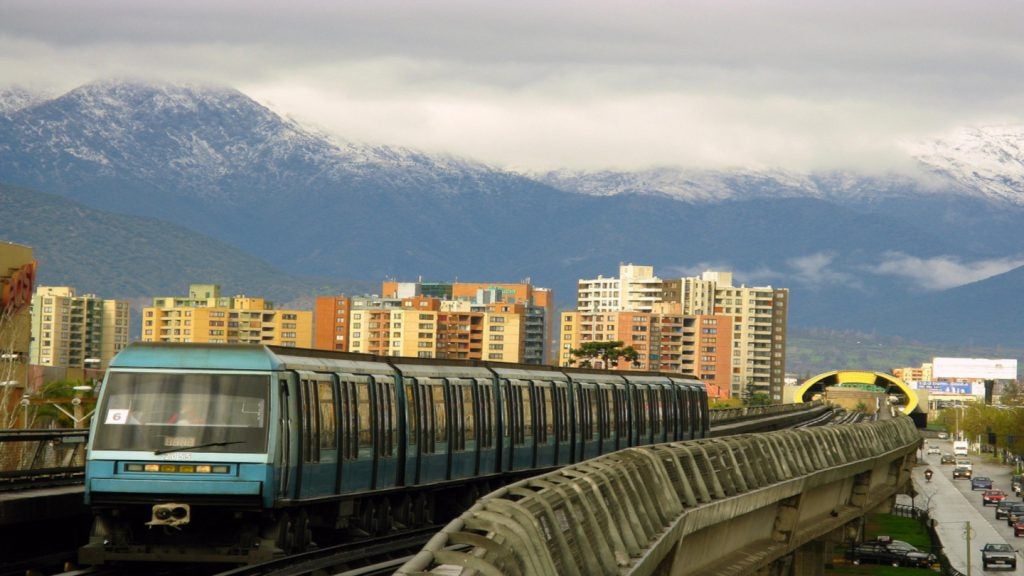
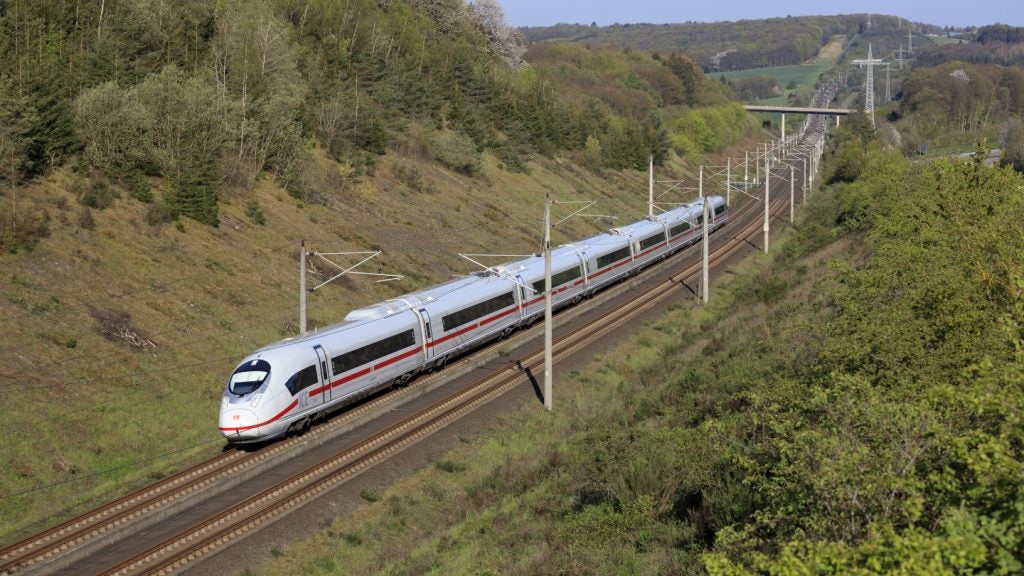
The rolling stock in use is a mixture of regional trains, long-distance express and heavy freight. As the line is built for speeds of up to 250km/h (155mph), 210km/h (130mph) X2000 tilting trains could use their capabilities for the fastest trains, supported by Rc electric locomotives capable of 160km/h (100mph) on slower trains and overnight services.
The Rc is also the mainstay of freight haulage in Sweden, with many owned by SJ freight subsidiary Green Cargo. Train weights are up to 1,600t, at least 300t heavier than the current line.
Given the northern routes have less heavy passenger patronage than in the relatively densely populated south, Botniabanan uses the 200km/h variant of the wide-bodied Bombardier Regina range which in other forms is already widely used in Sweden. Ordered by SJ during 2008 for delivery in 2010 with any option for more, these new four-car units with 3+2 seating allows fleet concentration of the ABB/Adtranz X2 (X2000 service) sets built 1989–98.
Principal passenger operator SJ is considering X2 replacement with 250km/h non-tilting trains, possibly evolving from the Green Train research project (also currently using Regina class vehicles) which includes Banverket and Bombardier. The Botniabanan could eventually see use by this next generation of front-line passenger stock.
Freight trains of up to 1,600t also link city centres, reducing the need for road transport in the area.
Signalling and communications
The Botniabanan is the first in Sweden to be fitted with European Traffic Management System Level 2 (ERTMS) that allows for no fixed line-side signals being fitted. Conducted initially at 40km/h (25mph) before gradually raising speeds, the first trials took place during April 2007 on a 20km section between Husum and Örnsköldsvik.
A former Austrian OBB Class 1142 electric locomotive without the standard Swedish signalling equipment is leased from Hector Rail by Banverket for ETCS Level 2 testing.
A safety system in the tunnels will prevent trains from coming to a halt in the long bores, some more than three miles long. To further increase safety there will be no level crossings of any sort on the route, with all paths and roads crossing under or over the line.
The future
Six million tons of freight is expected to need moving each year, and the project aims to attract business from the region’s roads. The old line, dating back to the 1890s, can carry five million tons of freight annually. The new line alone has double this capacity to allow for continued growth.
Although sections of the line are being phased into use by freight, installations continue and the final part of the project to be completed is that at the northern Umeå end.