
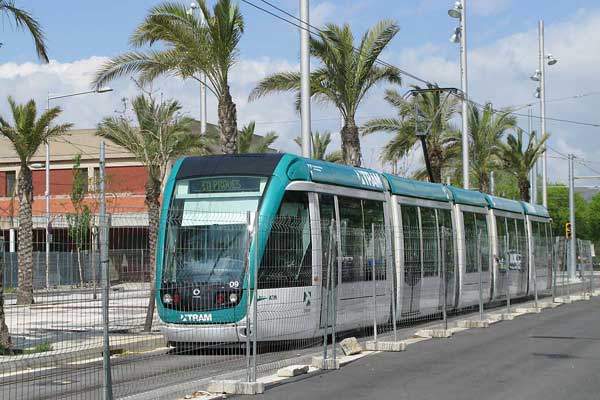
Boosted by hosting the 1992 Olympic Games, Barcelona on Spain’s north-east coast has continued to grow in reputation and economic standing. Capital of the autonomous Catalonia region, Spain’s second-largest city had developed an extensive public transport operation featuring buses, funiculars, metro and, until closures completed by 1971 (save for the Tramvia Blau tourist service), a large tram system.
A railway hub for Renfe’s long-distance services, Cercanias (local trains identified as Rodalies in Catalonia) and since early 2008 the eastern terminus for the high-speed AVE line to Madrid, Barcelona is also the focal point for regional operator Ferrocarrils de la Generalitat de Catalunya (FGC).
Recommended White Papers

Recommended Buyers Guides

Much of the city’s central road layout follows a grid layout that has long been prone to extreme congestion. Barcelona’s expansion has been through new settlement around the metropolitan area’s edges, also re-deployment of land use in vacated industrial areas.
With the former tendency leading to increasing journey times and the latter locations not being well-served by public transport, by the 1990s planners had decided that light rail could provide high-quality local transport in areas of need and also be provided at lower cost and more rapidly than a metro alternative.
To promote the tram’s return, albeit in a very modern form, an information point was located in the city’s main square, Plaça Catalunya and a short demonstration section installed near Plaça de la Reina María Cristina. Test runs were carried out using Alstom TFS and Siemens Combino trams during 1997.
THE PROJECT
With most features in common, two free-standing systems exist in Barcelona. The system names relate to districts served in the metropolitan area outside the city centre, Trambaix to the south and Trambesòs to the north. Services are primarily distinguished by the route number: T1–T3 (Trambaix) and T4–T6 (Trambesòs). Fundamental to both systems are multiple interchanges with other modes, larger examples being at Glòries and Cornellà Centre.
In 2000, a 25-year build/operate contract was awarded to TramMet (Tramvia Metropolita, SA), a French-Spanish consortium of Alstom (25%), FCC Construcción, Marfina, Arande, Comsa, Acciona-Necso, Soler I Saulet, CGT Corporación General de Transportes, CGEA Connex, Guiavia, BanSabadell Inversió Desenvolupament and Sociéte Générale. Construction on Trambaix started in June 2001.
The following July, TramMet also won the contract to build and operate Trambesòs, with construction starting on 9 January 2003. Services on both systems began in spring 2004 and loadings have continued to grow.
Since the core routes opened, there have been several extensions. From 2006, the T5 route was created, extending from a turn-back at Glòries on a section shared with T4 and a section from La Farinera to Besòs bundled with an urban motorway. The line’s new outer terminus from autumn 2007 was a bus and metro interchange at Gorg in neighbouring Badalona. Once TramMet’s 25-year concession on the two networks has expired, ownership and operation will pass back to ATM.
INFRASTRUCTURE
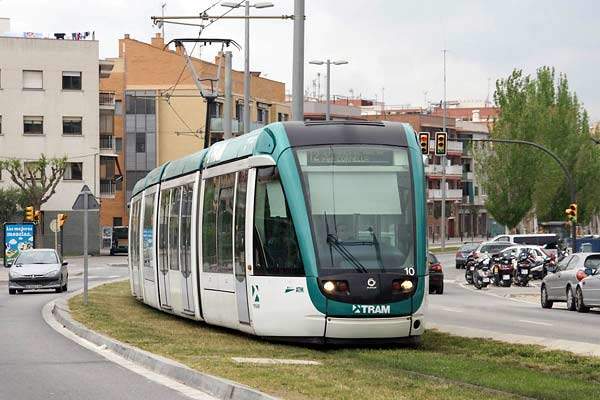
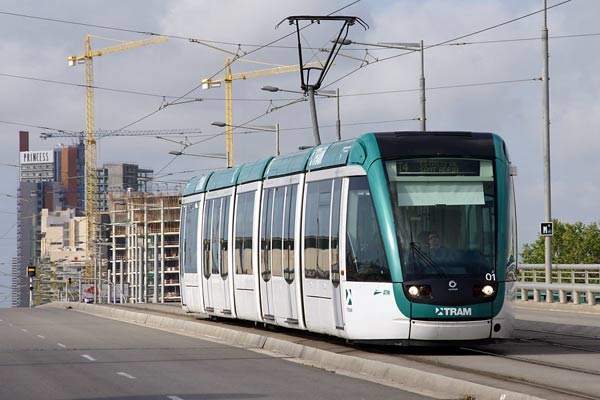
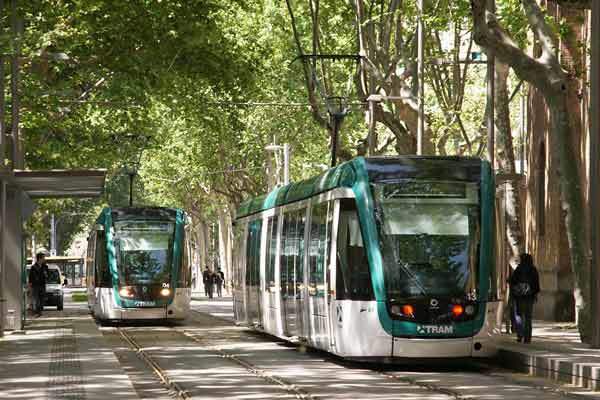
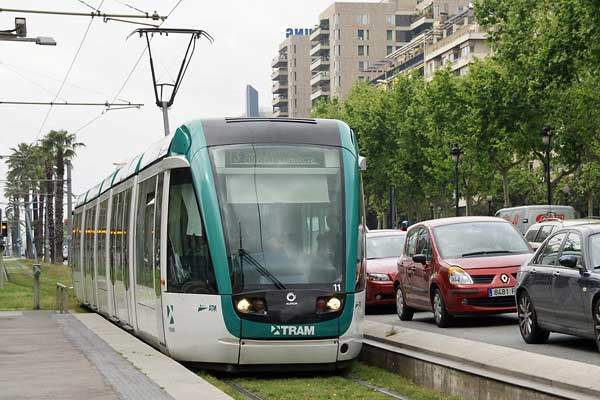
Installation included substantial reworking of roads and access for pedestrians, with much landscaping being incorporated. Largely on reserved alignments, the 1,435mm gauge mainly double track is laid on rubber pads fixed to concrete blocks, linked by steel spacers and using elastic rail clips. In common with many modern networks, there is widespread use of grassed tracks to soften the visual impact and reduce noise.
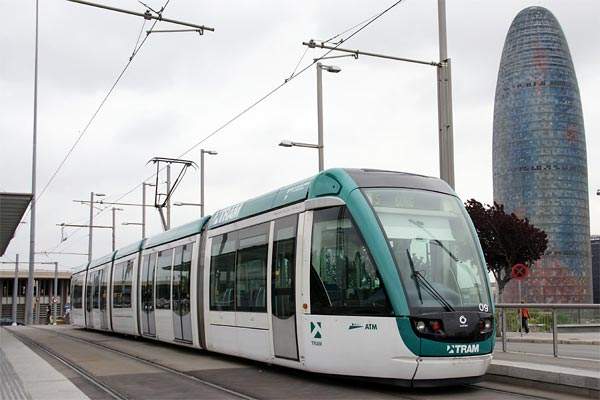
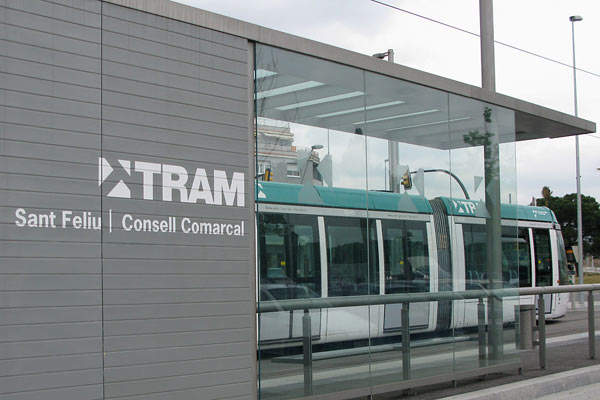
Notably along Av. Diagonal, Barcelona’s broad streets provided the space for the tracks to be installed between or alongside roadways. Multiple intersections in the grid areas in particular can delay trams, although at 20–25km/h, progress is double the average of buses in similar conditions. Tram stops follow a consistent styling, providing basic shelter, ticket machines and real-time displays.
ROLLING STOCK
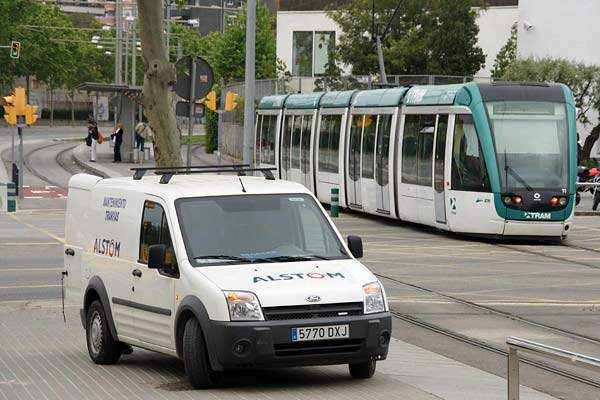
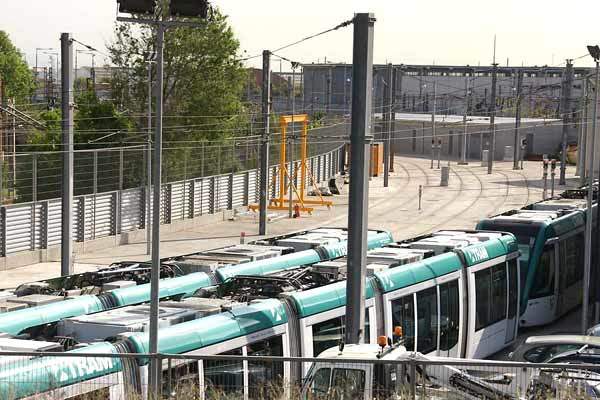
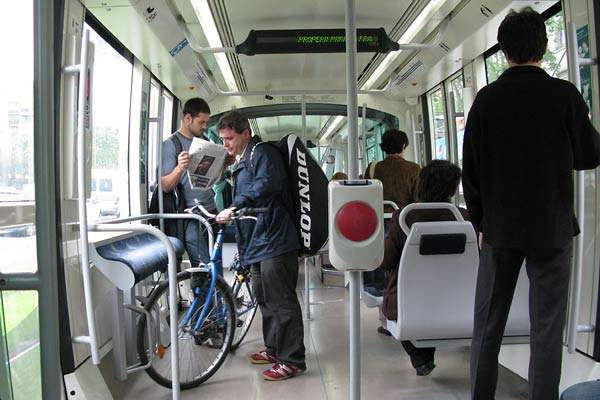
A fleet of Alstom Citadis type 302 vehicles work both networks, 19 on Trambaix, with 18 on Trambesos. The bi-directional 32.3m-long trams are 100% low-floor, air-conditioned, and can carry up to 218 passengers. The trams were assembled at Alstom’s plant in Santa Perpetua de Mogoda in northern Barcelona and are maintained at depots at Sant Joan Despì (Trambaix) and Sant Adria de Besos (Trambesòs).
In order to maximise safe operation, each unit is fitted with three forms of braking: electric, electro mechanical and mechanical. Under the original contract agreement, Alstom maintains the fleets for Trambaix and Trambesòs, and will continue to do so until 2029.
SIGNALLING / COMMUNICATIONS
Safety features including automatic train protection which can be used to override the driver and bring the train to a safe halt in the event of it passing a danger signal. Automatic train control adjusts the speed by an on-board computer which receives data from lineside monitor and signals. Internal passenger information displays are supplied with data from the central control room to show details such as the next station stop.
Audio announcements are in Catalan, as is signage which also gives key information in Castellano (Spanish) and English. Trams are included in the range of tickets within in integrated fare system.
This embraces all public transport modes and by 2006 in excess of 5 million people were within areas covered by Autoritat del Transport Metropolità (ATM).
THE FUTURE
Testing was taking place by spring 2008 on a new connecting line between the arms of T4 and T5. Featuring one stop (La Mina) and part of an urban renewal scheme, a new T6 will use the section from late 2008 to serve the outer ends of Trambesòs when there will be a related revision of route identities.
The public transport infrastructure 2001–2010 master plan included a plan to join the two systems with a 4km (2.5 mile) link between Glòries and Francesc Macià. With the prospect of extreme disruption and a cost in excess of €100m, to yield the full benefits of such a line across some of Barcelona’s most traffic-ridden streets, high frequencies and trams will be required.